Site Description
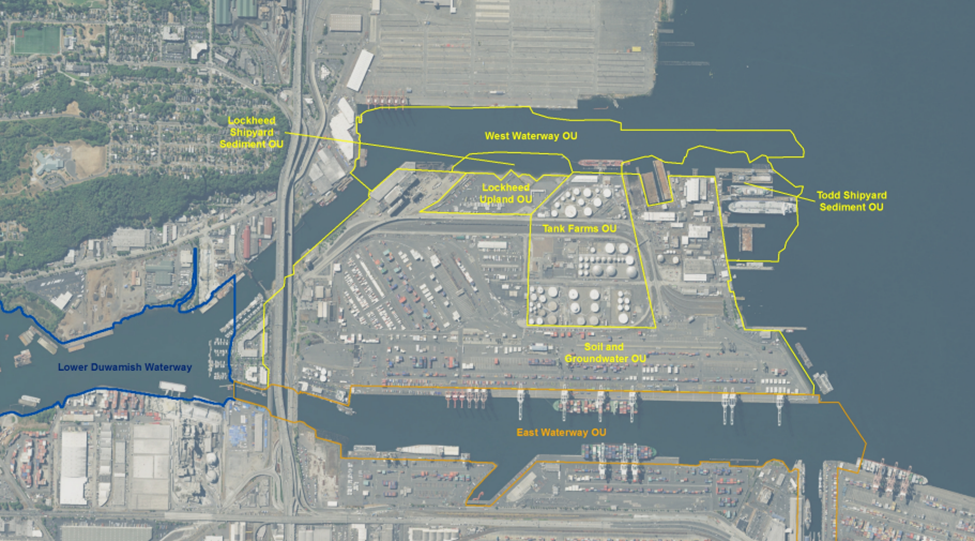
Terminal 10 (T-10) is located on the western side of Harbor Island at 2929 16th Ave SW, Seattle, Washington. T-10 is sometimes referred to as Lockheed Yard 1 or Lockheed Upland. T-10 consists of Harbor Island Superfund Site Operable Unit (OU) 03 – Lockheed Upland (LU-OU3 or OU3) and the adjacent Lockheed Shipyard Sediment OU (LSS-OU7 or OU7).
Site History
Harbor Island was constructed in 1909 by the Puget Sound Bridge and Dredging Company for the purpose of commercial and industrial ocean and rail transport operations. Historic use on the site included bulk fuel storage, secondary lead smelting, lead fabrication, ship building, and metal plating. Puget Sound Bridge and Drydock began operations at Yard 1 in the early 20th century.
Harbor Island was one of the first sites that EPA listed as a Superfund site in 1983. Harbor Island was divided into seven OUs, with OUs 3 and 7 containing T-10. Lockheed Martin led the cleanup work for this site, entered a Consent Order with EPA for OU3 in 1990 and for OU7 in 1996.
 Contamination Issue
Historical industrial practices (ship building, dry dock ship repairs, vessel sandblasting, and painting) at this former shipyard resulted in contamination of soil and sediment. The contaminants of concern at upland OU3 included petroleum, copper, and tetrachloroethylene (PCE). The contaminants of concern at sediment OU7 included hazardous substances associated with shipbuilding and maintenance such as arsenic, copper, lead, mercury, zinc, polyaromatic hydrocarbons, and polychlorinated biphenyls (PCBs).
What is the Port’s Role in this Cleanup?
The cleanup was completed by Lockheed Martin. As the current property owner of T-10 and pursuant to an agreement with Lockheed Martin, the Port oversees ongoing cap maintenance and groundwater monitoring.
Status
The cleanup for OU3 was completed in 1995. The selected remedy for OU3 included excavation and offsite treatment/disposal of contaminated hot spot soils. It also included an asphalt or reinforced concrete cap for soil contamination that exceeded cleanup goals but did not warrant removal, and it required groundwater monitoring for 30 years starting in 2005.
The cleanup for OU7 was completed in 2005. The selected remedy for OU7 included demolition of the existing pier, removal of 6,000 creosote-coated pilings, dredging and offsite disposal of contaminated sediments in the open channel area, and a sediment cap in the nearshore area. It was specified that the sediment cap must include habitat-friendly substrate.
T-10 and its adjacent sediments are currently in long-term monitoring. Five-year reviews are still being conducted on the site.
Groundwater monitoring at OU3 has shown exceedances of applicable cleanup levels for copper and PCEs, but these exceedances have remained stable and localized. OU3 has not shown signs of recontamination of the sediment cap at OU7.
Contact Information
Brick Spangler | Senior Environmental Program Manager | [email protected]
Additional Resources
Visit EPA’s Harbor Island Superfund Cleanup page for more information.