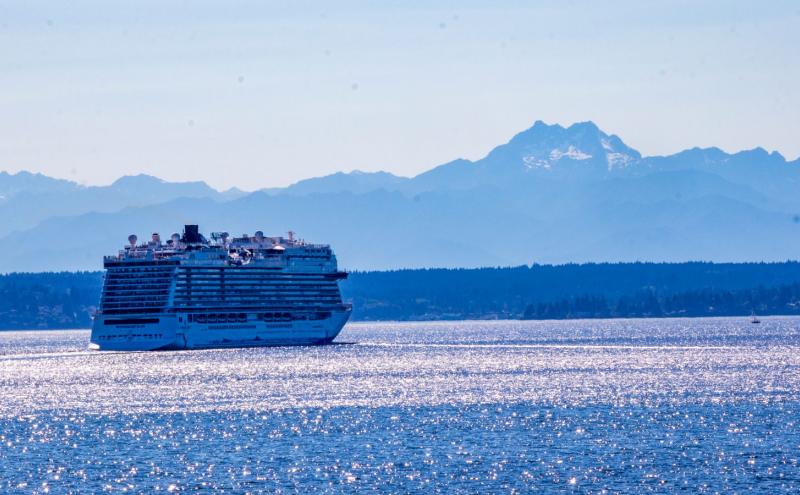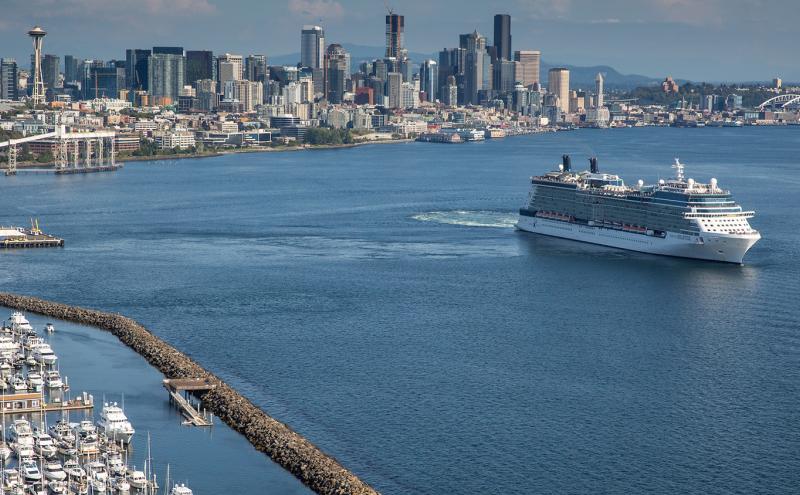
The Pacific Northwest to Alaska Green Corridor project is a collaborative partnership between the major cruise lines, homeports, and several ports of call in the Alaska cruise market to work together to explore low and zero- greenhouse gas (GHG) emission cruising between Washington, British Columbia, and Alaska. ‘First Mover’ partners include Port of Seattle, Vancouver Fraser Port Authority, Greater Victoria Harbour Authority, the Alaskan port communities of Haines, Juneau, Sitka, and Skagway, Carnival Corporation, Norwegian Cruise Line Holdings, Royal Caribbean Group, Cruise Lines International Association, Global Maritime Forum, Blue Sky Maritime Coalition, and Washington Maritime Blue.
What is a Green Corridor?
Green corridors are maritime routes focused on accelerating the adoption of low- and zero-emission fuels and technologies in shipping. Shipping accounts for nearly 3 percent of GHG emissions globally. While some sectors have clear pathways for how to transition away from fossil fuels, like the electrification of passenger cars, there is not yet a commercially available solution to decarbonize large 'oceangoing vessels'---ships traveling long distances at sea such as marine cargo and cruise ships. While several options for low- and zero-GHG emission maritime fuels are emerging and being tested in ships around the world, challenges remain to overcome technical, regulatory, and financial hurdles to using lower-emission fuels and technology at scale.
Green corridors bring together the key players within the industry - ports, ship owners, cargo owners, policymakers, fuel producers, and others - to tackle these challenges together on a specific route or region. Partnering across the supply chain allows each entity to coordinate their timelines and investments to ensure the production of new maritime fuels can be met with demand from ships equipped to use those fuels, and infrastructure to deliver those fuels to maritime customers. Identifying solutions to these challenges and demonstrating low- and zero-emission shipping at a smaller scale within a green corridor can spur the deployment of cleaner ships and fuels across the industry.
Green corridors as a concept emerged in 2021 when twenty-four countries, including the United States and Canada, signed the Clydebank Declaration to support the establishment of at least six green shipping corridors by 2025. While dozens of green corridor initiatives have been announced globally, the focus has shifted from forming partnerships to early operational phases, navigating bunkering and infrastructure challenges, and attempts to scale with regulatory and cost gaps.
About the Pacific Northwest to Alaska Green Corridor Project
The Pacific Northwest to Alaska Green Corridor (PNW2AK) project is exploring a maritime green corridor to accelerate the deployment of low- and zero-GHG emission ships and operations between Alaska, British Columbia, and Washington.
In a Project Charter (PDF), First Movers established the project's objectives, definitions, values, governance, and outlined a general approach for a feasibility study. Partners commit to:
- Working together to explore the feasibility of a green corridor in the Pacific Northwest of North America, including, but not limited to, further defining the scope and application of the green corridor concept;
- Enhancing and supporting the emission-reduction efforts already underway and using the green corridor as a testbed for low and zero greenhouse gas technologies and ships, as feasible; and
- Working collaboratively to define the governance structures, terms, and frameworks needed to guide this regional effort.
Feasibility Study
First Movers partnered with the Mærsk Mc-Kinney Møller Center for Zero Carbon Shipping (MMMCZCS) to evaluate the feasibility of green methanol cruise ships along the Pacific Northwest to Alaska corridor by the early 2030s. The completed study found the green methanol corridor technically and regulatorily feasible, but not yet economically viable, with an incremental cost gap exceeding $1.4 billion over 25 years. Realization of the project would also require addressing ongoing gaps in regional fuel supply, infrastructure, and safety protocols. Evolving U.S. policies since the study began in 2024 have added uncertainty to the project, which evaluated a U.S.-based green methanol production facility to serve the corridor. While the pending IMO Net Zero Framework could improve economics of green methanol in cruise compared to conventional fossil fuels, it will not close the gap alone. Because seasonal cruise demand makes dedicated infrastructure hard to justify, sharing infrastructure with other maritime users could strengthen the business case. If realized, the corridor would abate ~224,000 tonnes of CO₂e per season (~95% per ship), directly advancing the Port's and First Mover partners’ climate goals. MMMCZCS is involved in several green corridor efforts around the world, including a cargo shipping green corridor involving the Northwest Seaport Alliance and the Republic of Korea, which released a feasibility study evaluating the potential for green methanol for Pure Car and Truck Carrier (PCTC) vessels traveling between South Korea and the Pacific Northwest.
Pacific Northwest to Alaska Green Corridor Green Methanol Feasibility Study
PNW2AK Progress
- 2022: Launched partnership at the International Association of Ports and Harbors World Ports Conference in Vancouver, BC
- 2023:
- Signed a Project Charter
- Convened a public webinar with +150 attendees
- Scoped feasibility study and engaged support of Mærsk Mc-Kinney Møller Center for Zero Carbon Shipping
- 2024:
- Convened second public webinar with project updates and announcing Green Methanol Feasibility study
- Launched technical analysis on Green Methanol Feasibility Study across fuel production, port infrastructure, cruise vessel decarbonization, and passenger willingness to pay workstreams
- Explored approaches to measure and track GHG emissions
- Coordinated across partners on policy engagement, funding, and early action opportunities
- 2025
- Completed technical analysis on Green Methanol Study, synthesized findings across workstreams, and drafted final report.
- Continued First Mover coordination on communications and policy engagement, including tracking developments of the IMO Net Zero Framework
- 2026: Green Methanol Feasibility Study published and next steps in development
Project Partners
- Port of Seattle, Washington
- Vancouver Fraser Port Authority, British Columbia
- Greater Victoria Harbour Authority
- Haines Borough, Alaska
- City and Borough of Juneau, Alaska
- City and Borough of Sitka, Alaska
- Municipality of Skagway, Alaska
- Carnival Corporation and its cruise brands including Princess, Holland America Line, Carnival, Seabourn, and Cunard
- Norwegian Cruise Line Holdings and its cruise brands including Norwegian Cruise Lines, Oceania Cruises, and Regent Seven Seas Cruises
- Royal Caribbean Group and its cruise brands including Royal Caribbean International, Celebrity Cruises, and Silversea Cruises
- Cruise Lines International Association
- Global Maritime Forum
- Blue Sky Maritime Coalition
- Washington Maritime Blue