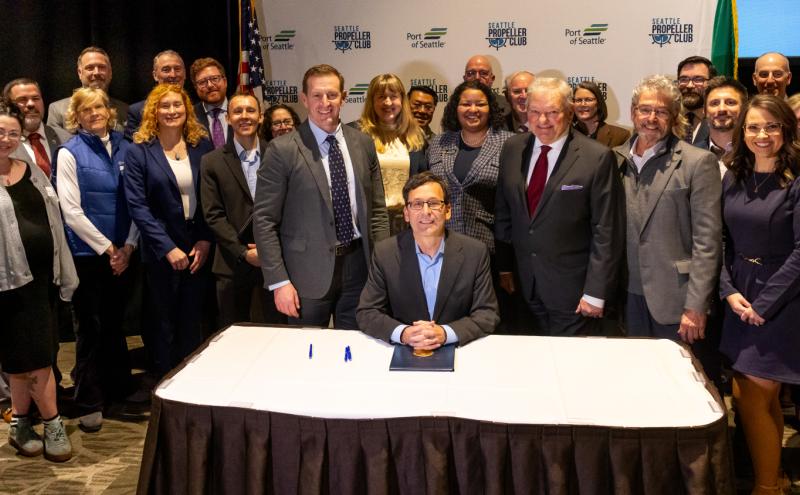
Today marks a major step forward in a coordinated effort to strengthen and grow the state’s maritime economy. Announced at the Pacific Marine Expo Economic Forecast Breakfast hosted by the Seattle Propeller Club, Governor Bob Ferguson’s Executive Order 26-07 guides the Washington State Department of Commerce to develop the strategy in consultation with maritime businesses, labor organizations, ports, Tribes, educational institutions, state agencies, and other stakeholders.
Catalyzed by deep engagement from public ports across the state, the action comes at a pivotal moment for Washington’s maritime sector. Renewed national attention on domestic shipbuilding, defense readiness, supply chain resilience, and maritime infrastructure presents a significant opportunity for Washington to attract public and private investment while expanding family-wage employment across the state.
“Washington’s maritime sector is a cornerstone of Washington’s economy,” said Governor Bob Ferguson. “To continue our success, we need to take action to position our maritime sector to lead in the future. Bringing everyone to the table and coordinating a cohesive strategy is a simple but powerful step to reaching that goal.”
A historic backbone in the state, Washington’s maritime industry supports more than 174,000 jobs, generates $14.4 billion in worker income, and contributes nearly $46 billion in annual business revenue. The broad-scale maritime industry encompasses shipbuilding and vessel repair, maritime transportation, commercial fishing and seafood processing, port operations, advanced manufacturing, defense activities, and emerging maritime technologies.
The strategy is intended to help Washington build on those strengths and organize around a shared vision for long-term maritime growth. It will identify opportunities to expand shipbuilding and vessel repair capacity, modernize aging infrastructure, preserve industrial lands, improve freight connectivity, strengthen workforce development, advance environmental sustainability, and attract additional investment.
“Today’s maritime industry in Washington — from our fishing fleet to our ferries, from container ships to Coast Guard cutters — is the quiet giant that has shaped our region’s economy and identity,” said Ryan Calkins, President, Port of Seattle Commission. “With increasing demand for ocean-based services, the industry is poised to grow. This statewide strategy will ensure that Washington state builds on our maritime heritage. The strategy will help us capitalize on our strengths in advanced manufacturing, clean tech, and the most capable workforce in the world to deliver the next generation of vessels.”
Building the capacity to compete
Washington is home to an extensive network of shipyards, boatyards, vessel operators, marine engineers, naval architects, manufacturers, technology companies, research institutions, and training providers. Its maritime economy supports commercial and defense operations and provides construction, maintenance, repair, and overhaul services for vessels of many sizes and types.
Washington shipyards have particular strengths in small- and medium-vessel construction, sophisticated steel and aluminum fabrication, advanced materials, and vessel maintenance and repair. Nearly one-quarter of the nation’s shipyards are located in Washington, and as of today 15 facilities across the state are capable of building commercial vessels up to 200 feet long using steel, aluminum, or composite materials.
Yet Washington’s maritime employers also face barriers to expansion, including limited industrial land, aging infrastructure, workforce shortages, financing constraints, permitting timelines, and the need for a more predictable pipeline of work. This Order will bring strategic guidance to the tactical, coordinated actions needed to increase access and investment in industrial lands, lower workforce recruitment and training costs, improve the financing environment, streamline permitting, and provide shipyards and suppliers with greater certainty about future demand.
A statewide roadmap for maritime growth
Under the Executive Order, the Department of Commerce will develop the strategy with input from stakeholders across Washington. The completed strategy is due to the Governor by September 30, 2027.
Specifically, the strategy will identify opportunities and recommend actions to:
- Strengthen Washington's maritime competitiveness, attract new investment, and leverage federal funding and defense industrial base opportunities, including potential maritime prosperity zone designations;
- Expand shipbuilding, vessel repair, and maritime manufacturing capabilities;
- Modernize aging maritime infrastructure, preserve industrial lands, strengthen freight connectivity and supply chains, and improve the capacity and resilience of ports, shipyards, and working waterfronts;
- Accelerate maritime decarbonization in vessels, terminals, and fuels;
- Expand maritime workforce development, support innovation and emerging technologies, and advance environmental sustainability;
- Grow sustainable commercial fishing, seafood processing, and aquaculture by expanding market opportunities and supporting industry resilience;
- Identify opportunities to streamline permitting and regulatory processes for maritime industrial facilities while maintaining appropriate environmental and worker protections; and
- Leverage international partnerships with maritime innovators, particularly existing collaborative efforts with Pacific Rim and Nordic nations, to support the priorities identified above.
Port of Seattle Executive Director Stephen P. Metruck and Port of Vancouver USA Chief Executive Officer Julianna Marler have played a leading role in bringing a maritime focus to the newly created Economic Development Council created by Governor Ferguson last June.
“We appreciate Governor Ferguson bringing public and private partners together to set a course for new jobs and activity on our working waterfronts,” said Port of Seattle Executive Director Stephen P. Metruck. “Maritime has so much growth potential in current industries and in innovation spaces. This collaboration sets up local businesses and workers to benefit personally, while the entire state can benefit from greater economic activity.”
“The creation of a new maritime strategy is a welcome announcement for a region where shipbuilding, innovation, and maritime commerce are part of our DNA,” said Julianna Marler, CEO, Port of Vancouver USA. “The Port of Vancouver USA, along with our sister ports throughout our state, are economic engines in our communities. Having a blueprint that clears barriers and incentivizes growth for ports and port-adjacent industries will equate to more prosperity in Washington.”
Today’s announcement complements work already underway among ports and maritime organizations. In 2026, more than a dozen Washington ports formed the Maritime Industrial Base Coalition through the Washington Public Ports Association to help strengthen the state’s shipbuilding and maritime manufacturing capabilities. The group is working to align ports around policy, infrastructure, workforce, and investment priorities.
The strategy also aligns with the Port of Seattle and Port of Vancouver USA's investments in workforce development, industrial lands, sustainability, and maritime innovation.
“Washington’s port system was created more than a hundred years ago to help ensure the public is benefitting from public resources,” said Eric ffitch, Executive Director, Washington Public Ports Association. “Across the state our public ports are delivering that benefit, whether by managing large marine terminals, maintaining public use marinas, developing industrial parks, or promoting tourism. Coming together to develop a State Maritime Sector Strategy will enhance these efforts and builds on momentum that has grown over the past year through our Maritime Industrial Base convening. With strong partnership from the Governor, the Department of Commerce, our private sector partners, and Washington workers, our maritime economy will continue to grow and benefit every Washingtonian.”
Washington is also expanding its international maritime and industrial partnerships. In October, the state signed a cooperative agreement with Denmark addressing port development, maritime decarbonization, sustainable fuels, industrial symbiosis, and related technology and business exchanges.
Together, these efforts are intended to demonstrate that Washington has the capabilities, partnerships, skilled workforce, and commitment needed to compete for emerging maritime investment and help lead the next era of American shipbuilding and maritime innovation.
About Washington’s maritime economy
Washington has one of the largest and most diverse maritime economies in the United States. The sector includes shipbuilding and repair, commercial fishing and seafood processing, cargo and passenger transportation, port operations, advanced manufacturing, maritime technology, and defense and national security activities. Washington’s strategic position connects Pacific trade routes, Arctic operations, the North Pacific fishing fleet, and major U.S. Navy and Coast Guard assets.