A colleague and friend, Denis Hayes (a founder of Earth Day) once said to me, “Fred, I’m glad the Port of Seattle has long-term net-zero carbon goals. But I’m more interested in what you’re doing to do to protect the climate tomorrow than by 2050.”
Recognizing the maritime industry can’t simply electrify ships sailing across the Pacific or even just to Alaska, the Port of Seattle held a two-day forum to explore the opportunities for and impediments to adopting the use of low-carbon fuels. With a broad cross section of participants from nonprofits, government, and the fishing, cruise, and cargo industries, we discussed near-, medium-, and long-term alternatives.
A few things became clear:
One: Our best near-term option is to accelerate the use of “drop-in” fuels derived from renewable sources, such as renewable natural gas and renewable diesel. These drop-in substitutes can be mixed with fossil fuels without requiring any ship modifications, and they can be introduced into the market incrementally, as incentives make their price and availability increasingly competitive.
Two: There is an immediate need for this effort as more than 50% of vessels currently on the order books can utilize liquified natural gas (LNG). The combustion of LNG produces significantly fewer particulates as compared to diesel exhaust. This reduces the air quality impacts on near-port communities. But to minimize the impact to the climate from this growing fleet, we will need policies and infrastructure that facilitate the use of renewable natural gas (RNG) — methane derived from landfills, farms, and sewage treatment plants, among other sources.
Three: There is a huge latent supply of RNG waiting for buyers. We need to work with our partners in government and industry to help unlock that supply. And we need to leverage our work on sustainable aviation fuel (SAF), given that renewable diesel (RD) can be made in the same refineries, with the same feedstocks. The sooner we are able to increase the amount of renewable diesel and renewable natural gas into the maritime ecosystem, the sooner we’ll see benefits to both the climate and near-port air quality.
Four: The Port hosts extensive public-facing programs focused on maritime, aviation, green jobs, and environmental stewardship. But we discussed the possibility of adding an additional series of public outreach sessions to our schedules — one that draws on the example set by the Port of Hamburg’s “beer and bratwurst diplomacy.” Highlighting the Northwest’s iconic seafood industry, we discussed calling this new series of meetings “chowder chats.” A regular gathering like this — in addition to or in consolidation of our other public outreach efforts – could go a long way toward shedding light on our efforts to keep growing the region’s economy and creating jobs in our region while protecting the environment. I’ve spoken to our executive leadership team and the team at Ivar’s about hosting these gatherings, and told them to “Keep clam — this is just an idea for now.”
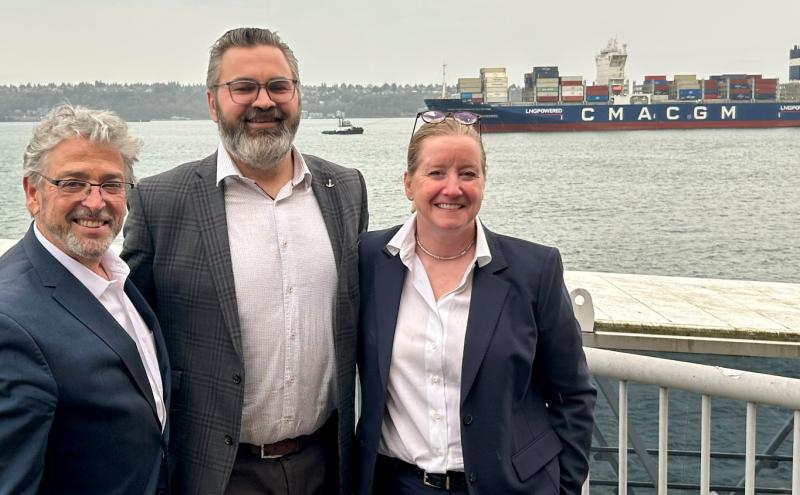
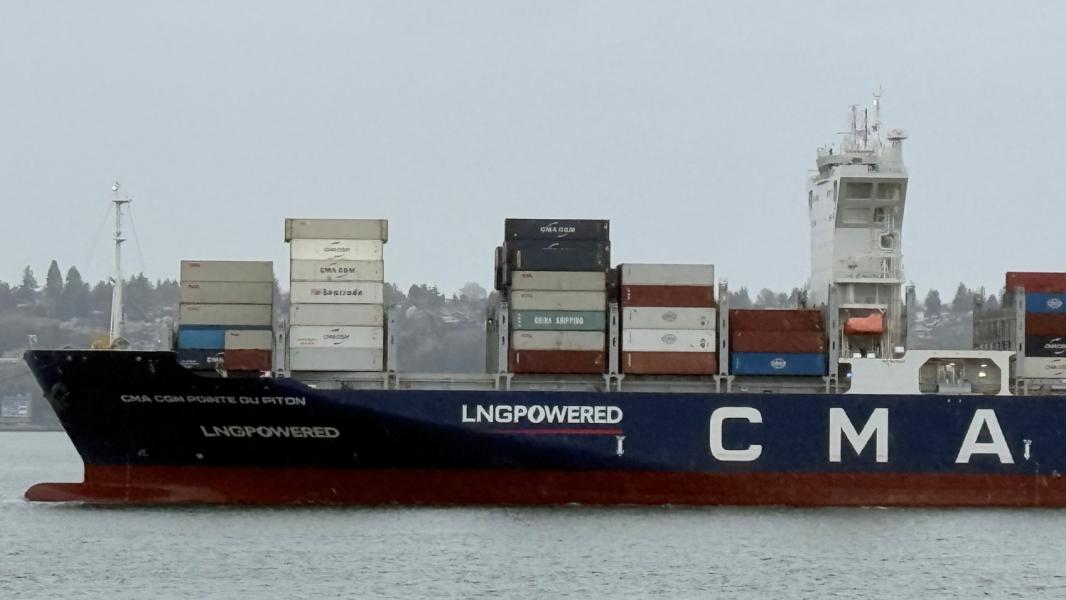
As if to underscore the urgent need to increase the supply and cost-competitiveness of RNG, we saw an LNG-powered CMA CGM vessel, bunkered by Seaspan Energy in Vancouver, BC, earlier this week, sailing by during our meetings. The photo at the top includes Heather Wood, a vice president of sustainability at CMA CGM, the world’s second-largest shipping line, and Harly Benner, Seaspan Energy’s president, posing with me in front of that ship.
Given it was a fuel forum, we didn’t discuss operational changes that could be implemented even faster than new fuels. That includes increasing the practice of "slow steaming" — operating container ships at significantly lower speeds than their top design speeds. This reduces fuel consumption and underwater noise and ship strikes, benefitting both the climate and whales. Such efforts, paired with more efficient route planning and other tools, could be a jumpstart on creating “Quiet Green Corridors.” (See the Blue Whales, Blue Skies program for an example of a related effort.)
I’m all for continuing to follow the maritime industry’s mantra of making continuous improvement in a changing environment. That said, I’ve been at this a long time. Witnessing seasonal temperature records break year after year has changed the meaning of the expression “moving at a glacial pace” for me.
Time is of the essence. That’s why I’m glad to be part of the effort to accelerate these efforts to take action now, so we can meet our goals well ahead of our 2050 deadline.
Photo at top: With CMA Vice President of Sustainability Heather Wood and Seaspan Energy President Harly Benner
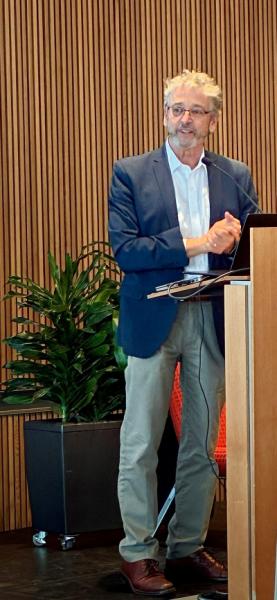
Second photo from top: Summarizing what we heard on Day One of the summit and where we might go from here to deliver a clean fuels future for the maritime industry
Subscribe to receive email updates from Commissioner Felleman