
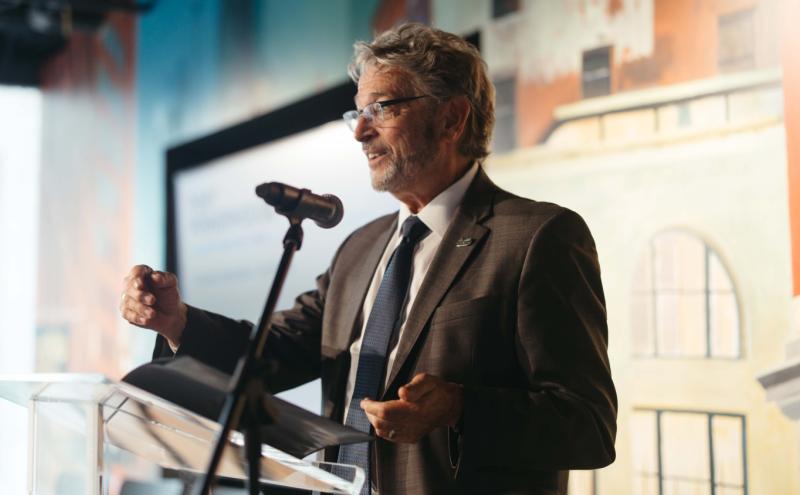
Climate Week 2026, organized in partnership with the United Nations General Assembly, brought together more than 100,000 people last month to learn from each other about efforts being taken to accelerate climate solutions across a broad array of governments and industries. I focused my attendance on those meetings centered on port-related efforts as part of the Port of Seattle’s delegation. While there were quite a few meetings to attend on the subject, they were hosted by different organizations and scattered throughout the city.
There was a general consensus between talks that we are still not doing enough to meet the challenge of climate change. My primary concern is that we are letting talk of long-term aspirations replace the urgency of acting now to bring down carbon emissions. That’s well supported by the United Nations Environment Programme’s recent report concluding that the world will see more than 1.5°C global warming in the next decade, compared to the pre-industrial era.

The week was full of interesting talks. One of the first sessions I attended included remarks from Albon T. Ishoda, Ambassador of the Republic of the Marshall Islands to Fiji and the Pacific Islands. As a member of an island nation, at grave risk from sea level rise, he reiterated the urgency of the climate crisis.
“In the fight against climate change, winning slowly is the same as losing,” said Ishoda.
I couldn’t help but find some irony in his statement, given that the Marshall Islands, while only three meters above sea level, serve as the third-largest ship registry in the world, offering vessel owners a flag that comes with significant regulatory and tax advantages compared to many other countries. But irony aside, his message was clear: to prevent further damage from climate change, long-term aspirations won’t cut it. The time for perseveration is over.
It was within this context that I spoke at three Climate Week events. The first, "Powering Up the Future of Ports," was hosted by the Environmental Defense Fund and Pacific Environment. During the round table discussion that included representatives from the ports of New York, New Jersey, and Oakland as well as a variety of nongovernmental organizations (NGOs), I shared what the Port is doing to bring down our own emissions and to facilitate our tenants’ ability to do the same. My intention was in part to identify areas where we could establish alignment between our political efforts for legislation and regulations that advance environmental protection and maritime trade.
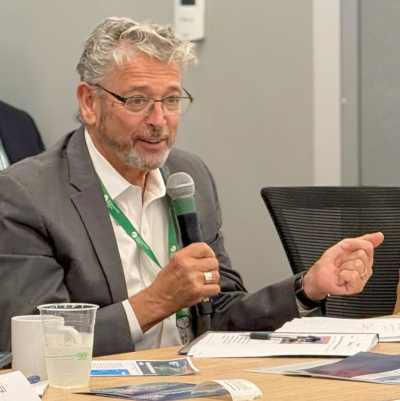
My next roundtable discussion, "Unlocking Investment in Nature-Based Solutions for Climate Resilient Ports," was hosted by an engineering firm called Arcadis. The participants were primarily lawyers, bankers, and investors focused on how to fund efforts to build resiliency to climate impacts. I contributed insights into how the Port has been able to advance habitat restoration and resiliency through mitigation banking.
The Port’s own event, Port Powerhouse, was hosted in partnership with the Port Authority of New York and New Jersey. I had the honor of opening the event and introducing the keynote speaker, Eric Garcetti, the Ambassador for Global Climate Diplomacy on behalf of C40 Cities Climate Leadership Group and former Mayor of Los Angeles. He spoke eloquently about the significant improvements California has made to improve air quality around its ports. He also noted that near-port communities that raised concerns about environmental justice years ago deserve credit for these accomplishments as well.
Heather Wood, Vice President of Sustainability at CMA CGM, the third-largest container shipping company in the world, brought that point home. After she heard someone compare the market’s inability to pick a sustainable fuel to a "chicken and egg" problem — a metaphor that was overused through the week — she offered a compelling retort.
“The chickens are already on the sea,” said Wood.
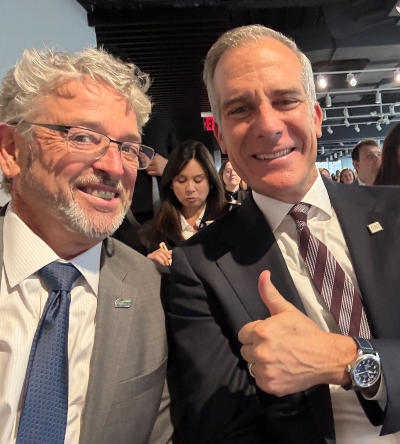
speaker at Port Powerhouse
The "chickens" she referred to are the LNG-powered ships CMA CGM and many other ship owners have invested in. Orderbooks now have a record 400+ LNG ships on order, representing an addition equivalent to nearly 50% of the existing fleet. The percentage is even higher for cruise ships.
CMA GGM, like many other ship owners and operators, would gladly use natural gas from sustainable and renewable sources to power these vessels, if it was available and cost-competitive.
That’s the challenge we face in the near-term — and that’s the challenge I want the Port of Seattle to stay focused on, while we continue to look at a multi-fuel future. Like our other green initiatives, I believe this will ultimately make the Port of Seattle more competitive.
It is imperative that we facilitate the use of Renewable Natural Gas, given the predominance of new vessels being designed to run on LNG.
Given that the methane escaping from dairies, landfills, and sewage treatment plants is escaping into the atmosphere, RNG can be carbon-negative if it also displaces the use of fossil fuel. The same is true for renewable diesel and sustainable aviation fuel — all of which are available now and can be used in existing engines.
Best of all, these drop-in fuels can be mixed in with existing fossil fuels so they can be phased in over time. Getting these things to scale will require a concerted effort and creative incentives. It will also take partnerships between ship owners, cargo owners, fuel suppliers, and governmental bodies. Ports have a central role to play in facilitating those relationships.

Port Powerhouse was a tremendously successful event — one that showcased this organization’s willingness to lead on climate change which is critical at this time with the federal administration relicensing coal-fired power plants.
By bringing together the Pacific Northwest’s expertise and tradition of entrepreneurship, we can capitalize on the generational economic opportunity of leading the transition to sustainable fuels for both maritime and aviation, as I explained in a recent op-ed in the Seattle Times. But we don’t have the luxury of waiting, and, when it comes to the panoply of options on the table, we can’t let the perfect be the enemy of the good.
I’ll end with a quote from former Secretary of State John Kerry who spoke at an event hosted by Bloomberg News. He castigated the Trump Administration for ceding the field of renewable energy to China, losing out on the economic and environmental benefits the technology promises, not doing enough to protect our oceans and fisheries, and generally ignoring the existential threat posed by climate change.
“Mother Nature has her own capacity to teach us some pretty tough lessons,” said Kerry. “And we’re seeing it. [The recent flood in Nepal] wasn’t just an avalanche or an accident. That was a glacier that imploded. And as it gets warmer, whatever is left of the other glaciers in the world could do the same.”