I returned from Helsinki, Finland, last month, where I was invited to make a presentation at the 14th Annual World’s Ocean Congress, entitled “Balancing the needs of Commerce, Community, and Climate: The Port of Seattle Experience.”
Like many conferences, the people you meet and the side trips taken add significantly to the experience — and made this trip even more worthwhile. Highlights included meetings with Kim Salmi, the managing director of Helsinki Shipyard; Pila Karjalainen, the CEO of the Association of Finnish Ports; and the head of nationwide vessel traffic monitoring programs at Finntraffic, Olli Soininen.
After just one visit, I can’t verify the claims that this small country on the Baltic Sea is the happiest place on earth — though I’m sure not having to worry about paying for education or healthcare are major factors. However, I can verify that the Finns are masters of maritime manufacturing. Finnish shipyards design and build some of the world’s most advanced icebreakers — with skills they have developed out of necessity. Finland is the only nation on earth in which every one of its ports freezes over in a typical winter. Their Targa powerboats and Nautor Swan sailboats are also among the most sought-after and seaworthy watercraft ever made.
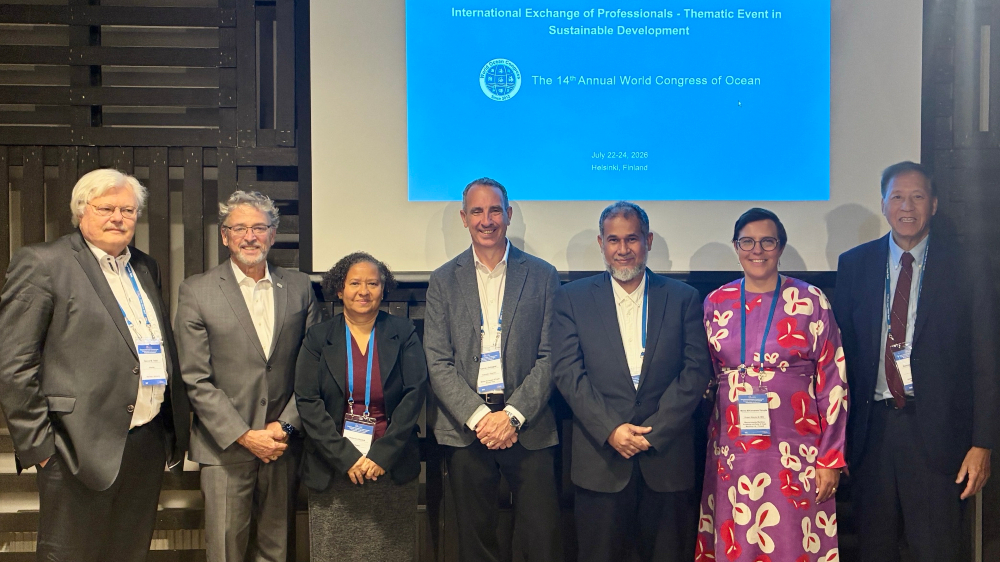
Commissioner Felleman stands with a group of other presenters from the 14th Annual World’s Ocean Congress
Even more impressive is the Wartsila Corporation — a global Finnish engineering firm founded in 1834 that has played a major role in every facet of the maritime industry over their long history. They are currently focused on decarbonizing the maritime industry by building the world’s most advanced marine engines, capable of burning multiple types of low-carbon fuels. This is essential as the maritime industry is still exploring options to replace fossil fuels, like ammonia, methanol, and liquified natural gas (LNG). As this eye-catching map shows, 31% of the global fleet — around 34,000 vessels — operates with Wartsila equipment.
I was fortunate to be joined on the trip by two of the Port’s partners: Patrick Gallagher, the executive director of the Marine Exchange, and Vesa Koivumaa, the head of strategic growth at Wartsila.
Patrick and Vesa have been working together to develop a way to provide mariners with real-time whale sightings displayed on their electronic charts, which I’m working to have adopted in Washington waterways. The goal is ultimately to make it easier for the industry to comply with the voluntary vessel slowdown program called Quiet Sound. By slowing down in the presence of whales, ships decrease underwater noise, thereby reducing interference with whales’ ability to communicate, find food, and navigate with their sonar.
“A sighting report that reaches a commercial mariner late doesn't protect anything,” said Gallagher. “We're building the network to make whale sightings as visible on the bridge as the ship traffic around them."
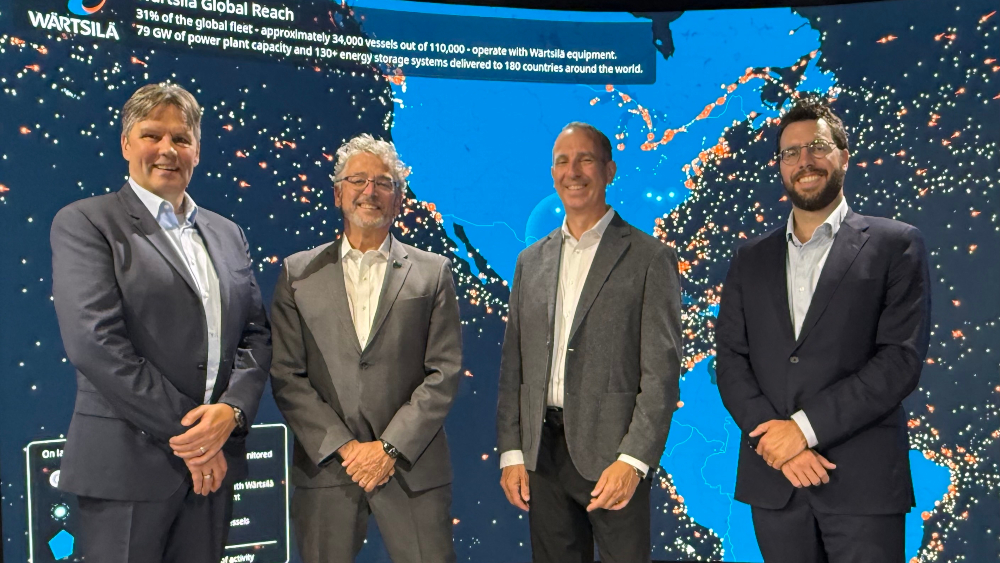
From left to right: Vesa Koivumaa, head of strategic growth at Wartsila; Commissioner Felleman; Patrick Gallagher, executive director of the Marine Exchange of Puget Sound; and Jim Mumford, strategic advisor to the Commission Office, standing in front of a map showing the positions of tens of thousands of vessels operating with Wartsila equipment around the world
The Port of Vancouver’s ECHO Program has been in operation for 12 years, and I championed the recommendation to adopt a similar program in Washington as part of former Governor Jay Inslee’s Orca Task Force — which led to the creation of Quiet Sound. However, the ECHO Program has a far greater rate of compliance than Quiet Sound. I am hopeful that this new effort will help make our program more successful.
Vesa was kind enough to arrange a tour of Wartsila’s factory for us in Vaasa, about 260 miles northwest of Helsinki on the Gulf of Bothnia. There, we had a chance to see firsthand the work Wartsila is doing to drive the maritime industry toward a fossil fuel–free future. It was inspiring to see family members working side by side assembling advanced engines with crankshafts that look more like gleaming sculptures than machinery.
The Port has partnered with Wartsila as we’ve pursued ways to facilitate the maritime industry’s adoption of cleaner fuels. Most recently, they joined the industry forum I initiated regarding ways to reduce the carbon footprint of LNG as a maritime fuel, while recognizing its benefits for air quality in near-port communities. It’s becoming clear that multi-fuel engines and alternative fuels that work in existing engines, like renewable diesel and renewable natural gas, are some of the most important tools we have in the near-term to slash the Port’s Scope 3 emissions.
Following the conference, I toured the Helsinki Shipyard, recently purchased by the Canadian shipbuilding company Davie. We met with the managing director Kim Salmi, to discuss the icebreakers his team is building for both the U.S. and Canadian Coast Guards.
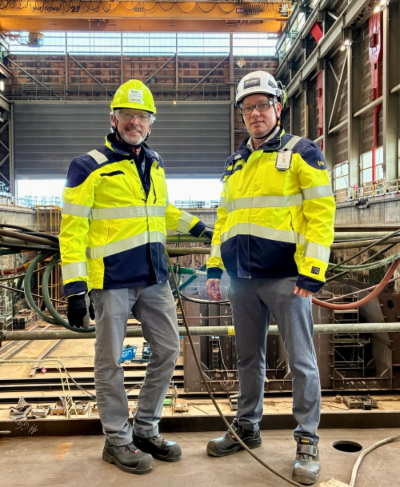
director Kim Salmi, in a bay where an icebreaker
is currently under construction
This work is being done in partnership with Bollinger Shipyards of Louisiana, which will provide their workers with a unique opportunity to learn from the Finns as they work to replace America’s three existing icebreakers, which are home ported in Seattle and long past their retirement.
The decision to build icebreakers in Finland has recently been a source of controversy, following a New York Times report that the White House waived the usual contracting procedures — not to mention a law — requiring that American shipyards construct ships for the armed services. However, unlike the no-bid contract used to resurface the reflecting pool in Washington D.C., it’s clear that the Finns are uniquely qualified to receive a sole source contract for this kind of work.
The shipyard’s managing director, Salmi, explained that their ability to build ships quickly is down to their deeply experienced workforce. They can handle both expected and unexpected challenges without losing time or missing deadlines.
“We are basically building a floating city in two years’ time,” said Salmi. “You have to have some dates set in stone, such as the date by which we will float the vessel. But with everything else, we need to be flexible and make room to handle variables.”
They build these boats modularly, joining together giant steel "blocks." To emphasize their attention to detail, Salmi noted that they have a 10 mm margin for connecting these multi-story modules, and that they aim for margin of half that much, or less than 5 mm.
Among the many take-home lessons I learned was that the Finns’ ability to skillfully build these world-class vessels quickly was not due to automation. Rather, it’s the investment they’ve made in training their people, who brim with pride in knowing the quality of their work.
The opportunity to meet the people who are designing and building the maritime fleet of the future was an eye-opening education, and one that will enable me to continue informing the Port’s efforts to seize the opportunity of the federal government’s intention to reinvigorate our nation’s shipbuilding capacity.
From the large shipyards in Bremerton and Elliott Bay that build and service government and commercial vessels to the numerous smaller ones along Puget Sound with their unique capabilities honed by experience building the Alaskan fishing fleet, Washington has a proud history of building ships. I look forward to helping the Port of Seattle build on that legacy.
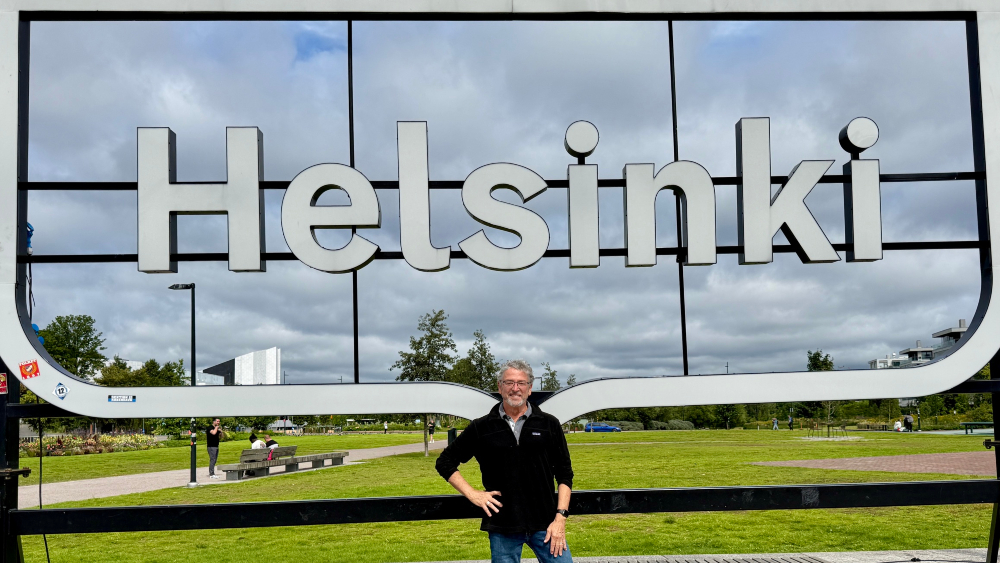
Commissioner Felleman in Kansalaistori Square
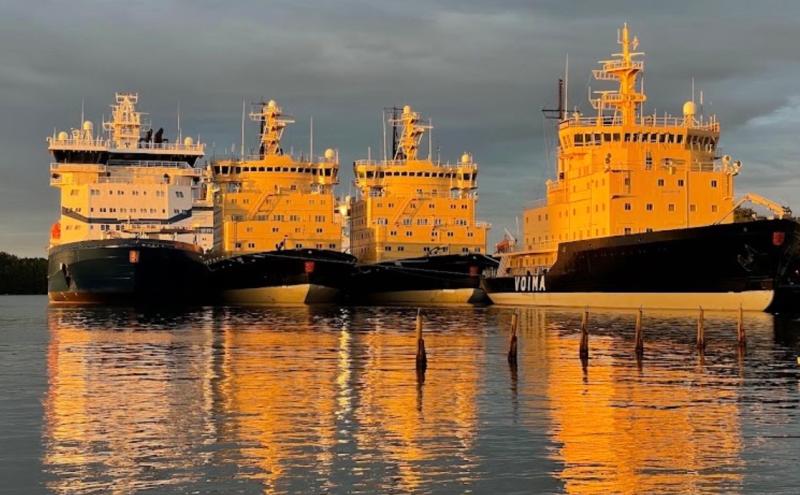
Photo at top: Icebreakers at the Port of Helsinki
Subscribe to receive email updates from Commissioner Felleman