May 14, 2026
When the new C Concourse opens later this spring at Seattle-Tacoma International Airport (SEA), not only will it raise the roof, literally, by adding four additional floors above the existing building, it will raise the bar on the airport experience and sustainability. Through thoughtful and innovative design, the C Concourse Expansion increases the existing 81,000 square foot building to 229,500 square feet that blends calm and connection with sustainability and regional identity, weaving in natural light, Pacific Northwest materials, and expansive views.
In designing the C Concourse Expansion, architects Rich Whealan, Principal at The Miller Hull Partnership, and Billy Schreiber, Project Leader at Woods Bagot, looked beyond the traditional model of airports as enclosed, inward-looking spaces. Instead, they looked outside their door, drawing inspiration from public open spaces and natural landscapes in the Pacific Northwest and beyond. The result is a design that brings the outside in — using vertical openness, daylight, iconic views, and natural, local materials — while setting a new standard for sustainability at SEA. “From the start, we set out to create a place that felt unmistakably Seattle — a space where travelers could feel the culture, the craft, and the natural beauty of the Pacific Northwest the moment they stepped inside,” Whealan said.
The space also reflects SEA's design standards.
“The C Concourse Expansion embodies the architectural guiding principles that our public spaces be integrated, intentional, inviting, inclusive, inspiring, and innovative. The architectural elements from the central tree to the color palette used throughout the space are a beautiful, modern interpretation of the Cascade Range as defined in the architectural vision for Concourse C,” said Heather Karch, Port of Seattle Aviation Facilities & Infrastructure Architecture Manager.
A place to gather
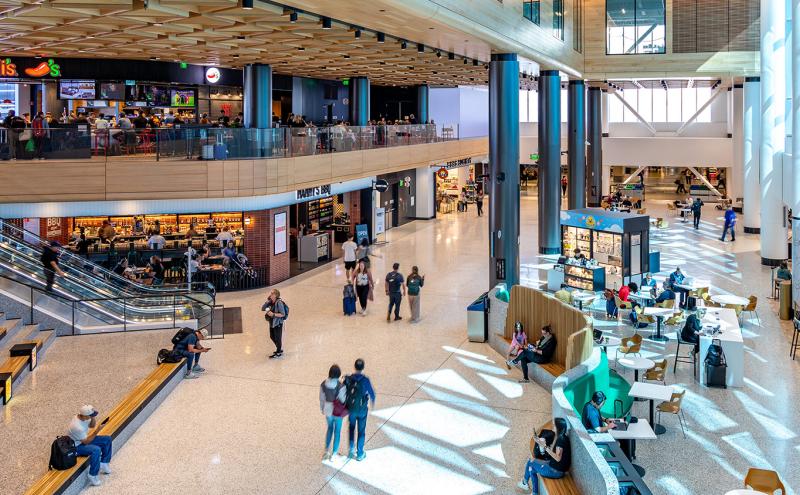
The main floor of the new C Concourse (Concourse Level) forms the base of a tiered atrium, an open amphitheater-like space with an area for live music, framed by dining and retail. Located near the C2 gates — an area with frequent commuter flights — the expanded C Concourse is designed as a hub with Seattle locals and regular visitors in mind. Seattle’s identity is reflected throughout the design, materials, energy, and vibrancy of the space.
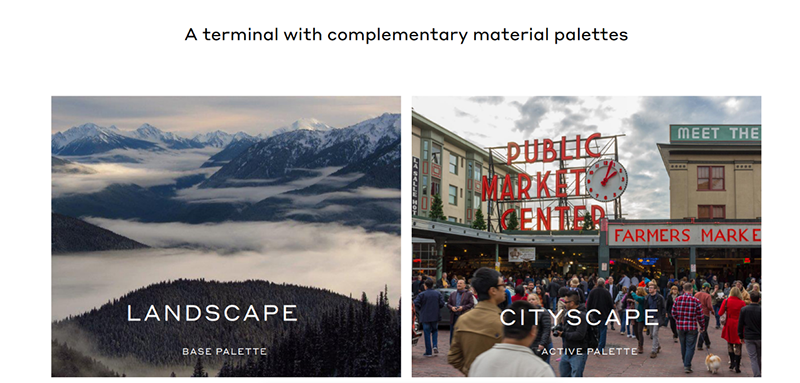
The atrium marketplace invites travelers in to find a moment to pause and connect, drawing inspiration from local outdoor markets, particularly Pike Place Market, with retail and dining positioned across multiple levels. The ground floor includes six kiosks within a compact footprint, creating an inviting, market-like atmosphere.
Artwork throughout the space reflects the Pacific Northwest. Artists Fumi Amano and Crystal Worl created blown glass pieces, an important regional art form, during residencies at Pilchuck School of Glass and the Museum of Glass in Tacoma. Fifteen “art boxes” are embedded within the Grand Stairs, featuring work from local and national artists. A sensory room will include a glass tile mosaic created in collaboration between two Seattle-based artists. Rotating digital art pieces from three artists will also be on display.
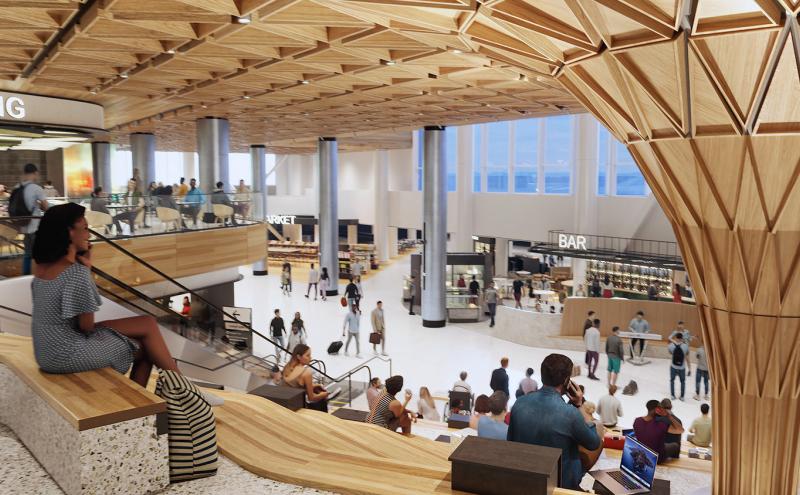
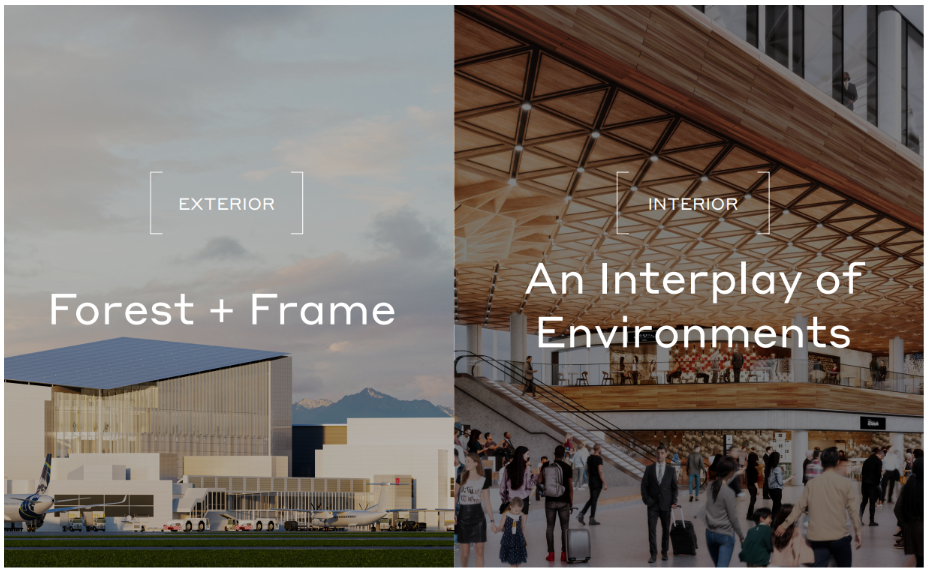
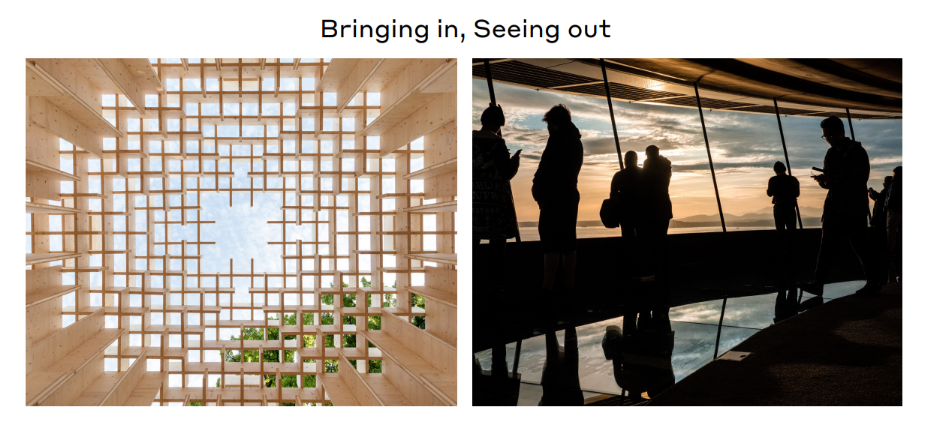
At the center of the Concourse Level is the Tree at C, the focal point of the gathering space. The triangular wood ceiling, inspired in part by the building’s folded exterior façade, is similar to the effect of a forest canopy filtering sunlight and gathering energy. The tree trunk was added to address the challenge of integrating structural columns into the design while maintaining a canopy-like aesthetic. As a result, the tree’s trunk drops down from the 30-foot ceiling to halfway up the Grand Stairs, drawing people in and up to explore the upper levels.
“The idea came through iteration and the more we sketched it out, we saw that it happened to be in kind of a sweet spot — the way circulation happened around it, and the way the Grand Stairs tucked into that mezzanine level,” Schreiber said.
The Grand Stairs, located at the heart of the atrium, functions as both a circulation path and a central gathering space. Its gentle slope invites travelers to sit, pause, and take in views in either direction, while also providing an accessible connection between the Concourse and Mezzanine levels, making it feel physically closer. At its base, in the center of the concourse is a dedicated busker area for local musicians to perform as part of Sounds at SEA, the airport’s music program.
A place of respite
Anticipating the way people would move in, out, and through the new space played a key role in the design. The expansion helps redirect traveler movement between the C and D concourses, areas that are often space constrained, drawing them into a central, spacious, daylit hub for dining and retail.
While the space feels expansive, it also offers small nooks and vantage points to experience the space in different ways. Travelers can choose to place themselves in the middle of the buzz on the Grand Stairs, or find a moment of peace away from the hustle and bustle. Seating can be found throughout this new space — outside tenant areas, a cozy nook tucked behind a column, a daylit window seat, or in the Nursing Room, Interfaith Prayer and Meditation Room, or Sensory Room on Level 3.
“I think there are many ways to experience the space while still feeling connected to it,” Schreiber said. “Because it sits just off the main circulation path, I hope it becomes both a gathering place and a moment of respite from the rush of the concourse.”
Drawing people up
With a limited footprint to work with, the only way forward was to build up. This constraint became an opportunity to design a space that drew people up, maximizing daylight, views, and transforming normally standard circulation elements like stairs and elevators into defining features.
The Grand Stairs and Switchback Stairs between the Mezzanine Level and Level 3 are essential for drawing people to the upper levels to enjoy additional dining, other services and amenities, and the Lookout at C, a public lookout deck. Each level of the building is slightly set back, allowing clear sightlines throughout the space and reinforcing a sense of openness and connection. Building vertically allows for views in every direction, helping to ground people in the space.
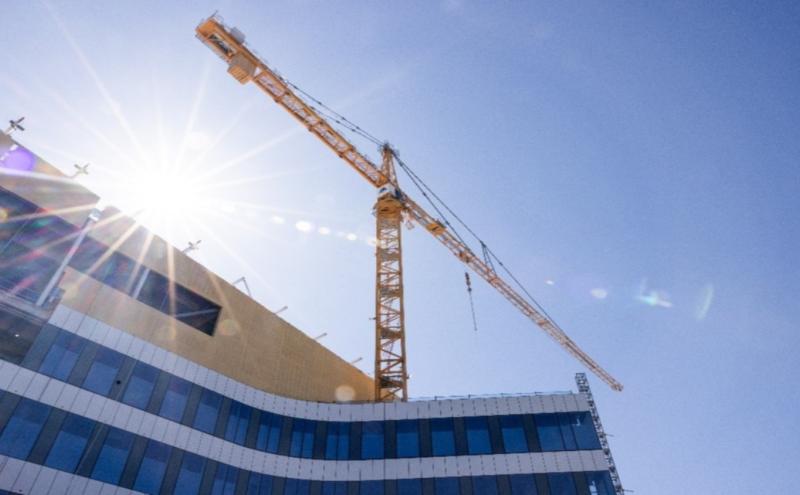
The roof slopes at an Federal Aviation Administration (FAA) prescribed angle relative to the runways, maximizing the interior volume of the building and is the home of an energy efficient rooftop solar array. The structure rises from its lowest point in the west to its highest point in the east, contributing to SEA’s evolving skyline alongside the Central Terminal, International Arrivals Facility, N Concourse, and Airport Office Building.
Space layout
- Concourse Level: Features local businesses, including Nanny’s BBQ and Seattle Macaroon Company, along with a pet relief area and high-visibility services.
- Grand Stairs: Connects the Concourse and Mezzanine levels, is centered around the base of the Tree at C, and equipped with power outlets and table art.
- Mezzanine Level: Features a mix of national and local dining options, including Buffalo Wild Wings, Chili’s, Port of Subs, and Great State Burger.
- Switchback Stairs: Inspired by the design of a hiking trail and connects the Mezzanine Level and Level 3 with views out the folded façade window wall to the airfield and Olympic Mountains.
- Level 3: Features the Lookout at C, an open-air viewing platform, quiet rooms (sensory, nursing, meditation), future flexible tenant office spaces, and an interior waiting area with expansive views.
- Levels 4–5: Includes future flexible space for lounges and offices, designed with strong sightlines and adaptability.
Seeing out to the region
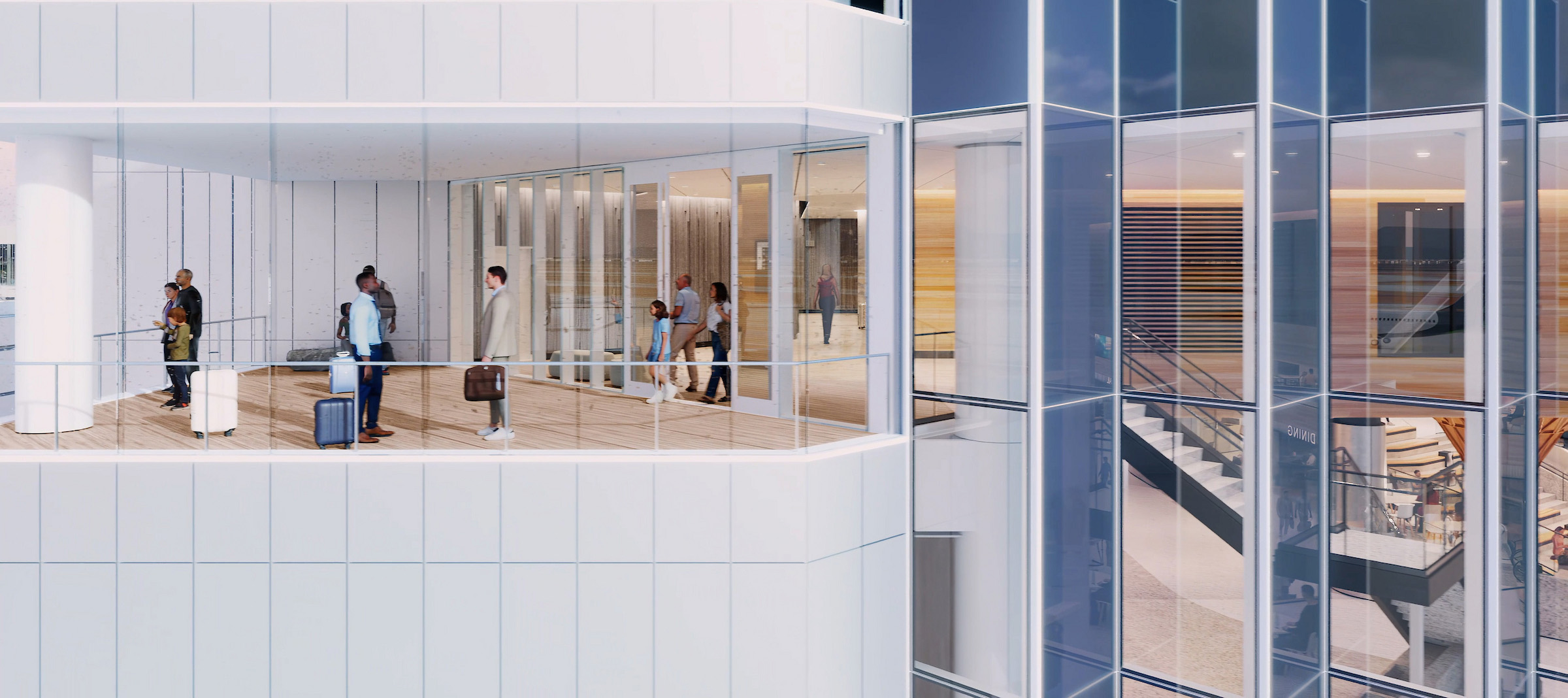
Another key design goal was maximizing daylight throughout the space. To accomplish this, a large folded façade window wall facing southwest uses electrochromic (dynamic tinting) glass to balance daylight and solar gain, allowing daylight to be optimized or shaded as needed. “We thought the effect was analogous to emerging from a forest into a clearing where you get that same kind of filtering of light,” Whealan said.
The folded façade windows are made up of five-foot wide glass panels. Each pair creates an effect similar to individual bay windows, offering personal vantage points within the larger space. The design minimizes the use of columns, which allows for unobstructed views across the concourse and outside to the airfield and beyond.
The Lookout at C, located on the third floor at the west corner of the building, is the perfect spot for views of the runway and Olympic Mountains. The design embraces the sensory experience of the airport, including the sounds of the airfield and the outside air.
A full-height glass barrier includes openings to allow fresh air to circulate, bringing travelers closer to the outdoor environment. Wood decking and basalt stone elements add a quiet, contemplative quality to the space out on the viewing platform while transitioning to a similar wood flooring feel through the inside space.
A building that belongs to the Pacific Northwest
Many materials used in the C Concourse Expansion were sourced locally or regionally, deepening its connection to the Pacific Northwest.
- Western Hemlock: Used for the 15,000-square-foot wood ceiling and Tree at C, this native species forms a warm, branching canopy that defines the space.
- Terrazzo stone: Used for cool, polished flooring, shaped by regional geology, and made from aggregate from regional quarries.
The C Concourse Expansion is the first project at SEA to follow the Port’s Sustainable Evaluation Framework, a process to transparently evaluate alternative, sustainable approaches to build capital projects where environmental and societal impacts inform project design, alongside cost and schedule.
Key sustainability features include:
- All-electric systems (heating, hot water, and cooking equipment)
- Rooftop photovoltaics, an energy efficient rooftop solar array
- Dishwashing capabilities to reduce solid waste and storage location for donated food
- Low-flow water fixtures that help conserve potable water
- Electrochromic glazing for windows
- Biophilic design strategies which create a comfortable environment and a symbiotic relationship between design expression and sustainability
- Project pursuing LEED Gold Certification, targeting LEED Platinum
- Buckling resistant braces (X-braces) reduce the weight of the structural steel frame with dramatic carbon reduction