November 26, 2025
The Port of Seattle exists on Indigenous land. Indigenous land that is the ancestral homelands of those who walked here before us and those who still walk here. We are grateful to respectfully live and work as guests on these lands with the Coast Salish and Native people who call this home. The Port of Seattle has also greatly benefited from the contributions of Native American-owned businesses and artists.
In honor of National Native American Heritage Month, the Diversity in Contracting team had the pleasure of conversing with Ty Juvinel, owner of Tribal Lines, about his journey as a Native artist and business owner. We are excited to share his heart for community, love for his people, and journey as small business owner.
Background
Tell us a little bit about your professional background and what inspired you to begin your business.
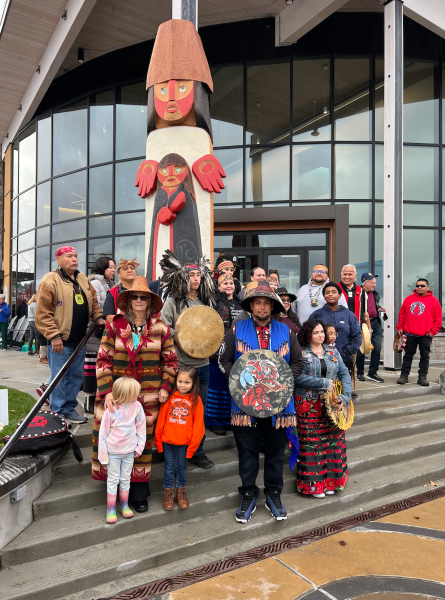
I’m a Tulalip tribal member and grew up in Tulalip my whole life. When I was young, I loved drawing my favorite anime and cartoon characters. My mom would say I always had a natural talent for it. However, it was working with my grandpa and Uncle Dave where I took a leap in my progression as an artist.
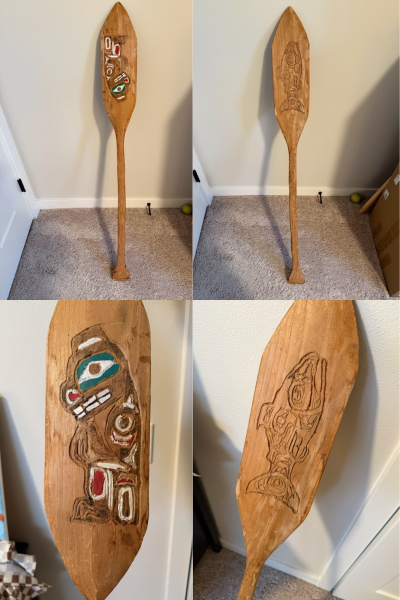
My grandpa had these wood planks he was going to turn into paddles, and one day, my Uncle Dave, him and I all worked on them together. My uncle and grandpa would share with me what they were working on, and it inspired me. I continued drawing and got into graffiti art, and the practice I would put into those arts transferred into carving and practicing tribal art. You’d think that I was always going to be an artist full-time, but I didn’t think that. I never thought my talent was important because off the reservation, being a skilled artist isn’t valued all that much. I accepted that art would just be a hobby.
I tried all different types of jobs; retail, carpentry, I was even lined up to be an electrician with a big electrical contractor. Those jobs were great but took a toll. Then one snowy day, I was standing in a muddy ditch burying conduit and someone made a remark over the radio saying, “This is what you get to look forward to for the next 30 years.” I couldn’t see myself doing this for too much longer, so I radioed back and said, “Hey this is Ty. I think I’m done working this job.” They laughed over the radio, but I explained to them that I wasn’t joking. That day I turned off my radio and set my sights on going back to school.
From 2007-2010 I attend The Art Institute of Seattle for audio production and found a job working for the Tulalip Tribes. They didn’t have many audio needs, however, so I did marketing and graphics for our tribe. Then an opportunity opened for me to work in our Tribal Arts department, so I began working with them. Working in the Tribal Arts department, I had found the type of work I wanted to do for the rest of my life. It was a blend of the things I loved. I was able to still do my childhood passion, and I also got to work with my hands and transform abstract ideas into physical pieces of art.
I was able to still do my childhood passion, and I also got to work with my hands and transform abstract ideas into physical pieces of art.
In 2010, I began my sole proprietorship, Tribal Lines, and continued my passion outside of work and started looking at opportunities outside my full-time job for Tulalip. My first professional opportunity off the reservation came in 2011 where I painted the doors of tiny homes around Seattle though the Low Income Housing Institute (LIHI). That turned into another project with LIHI, doing artwork for an apartment building in Olympia where I carved a panel, mask, and did some wall paintings for the building. Those projects are what really helped me take off.
I started art out of necessity. I had to keep doing tribal artwork as my job and I didn’t think I was just going to start a tribal arts company. Now that I do have my company, I’m inspired to continue illustrating the customs of my people and one of these days I’m hoping to fight for my right and my people’s rights to uphold and preserve our customs without interference.
What type of art do you do and where is your artwork found?

I specialize in Coast Salish artwork which is heavy on carving and painting. Coast Salish art has been generalized within the categories of Northwest Coast or Pacific Northwest Coast art. Coast Salish artwork is really the traditional art of this region but there isn’t as much representation of Salish art in our region as I think there should be. Many people believe that the Alaskan totem poles they see here represent Native Alaskan people taking over land in Washington but that isn’t true. There were some Alaskan tribes that were migrating south and ended up rooting themselves in Washington so that’s why their art is here. Also, some of it was purchased by universities or art brokers. It’s great to have a great amount of Native art here but we’re still waiting for our people’s art to be represented.
In thinking about what contracts to take and who to work with, I go back to the importance of putting my community first and the practices of my role models. My grandmother was a teacher, and she was always in the community teaching and seeking to preserve the Lushootseed language. My mentor, Alfred Charles Jr., always reminded me of the importance of being able to walk into my community because even though I’m producing the art, it’s our art. I’ve prioritized that art being in community spaces because it’s more accessible to all people no matter what their socioeconomic background. I've had personal experiences with my family being in places where my art is showcased but where they received more hostility than hospitality and were badgered with questions about why we're at their establishment. Extractive spaces where our art was welcomed but not our presence. Extractive spaces where they embrace saving the man but killing the savage.
I've had personal experiences with my family being in places where my art is showcased but where they received more hostility than hospitality and were badgered with questions about why we're at their establishment. Extractive spaces where our art was welcomed but not our presence. Extractive spaces where they embrace saving the man but killing the savage.
I prefer doing pieces I can contribute to a community because I’ve seen them have greater reverence for our people and they have been sensitive about the messaging around our art. It’s important for us to have a say in the narrative of our art because we already have enough instances in which our story and history have been altered and erased. You can find some of my pieces at City of Kenmore, ƛ̕ax̌ʷadis (TI' awh-ah-dees) Park in Kenmore, The Kenmore Hangar, Edmonds Waterfront Center, Skagit Community college, and other places in the region.
Contracting with the Port
What project are you currently working on at the Port?
I’m currently making an aluminum sculpture depicting a fisherman hauling in his catch of various seafood for the Maritime Innovation Center at Fishermen’s Terminal! The design I’m doing is called “Beach Seining” and it’s the main art piece. Beach seining is the method of casting a net by hand and swooping and cinching in the catch. I did this design to pay respect to all our coastal fishermen who are seining but also diving to feed their community. I lost my cousin as he actually drowned doing a dive so I’m reminded of the risks these fishermen take to feed all of us.

This project is something that I’m thankful for because I’ve had the design for it for maybe ten years now. It was one of the designs I knew I needed to hold onto for the right project. Before I got this project I responded to a Request for Proposal for the SEA airport as well. I didn’t win but I received a lot of encouragement to keep my eye out for the Maritime Innovation Center project. Someone saw my design and thought it was better geared for the Maritime Innovation Center and I couldn’t agree more. When the contract came out, in the description it said the artwork was to focus on fishing in the Pacific Northwest and North Pacific weaving in elements of history, culture, and heritage of fishing in our region. They say people may only be able to do a handful of great things in their life and I felt like this design was one of those handful of things for me. This was the perfect project for my design.
How does contracting with the Port differ from your other contracting experiences? What advice would you give other artist looking to contract with the Port?
One of the big differences in contracting with the Port compared with other spaces and municipalities is the level of detail the Port goes through with every step. They need to see evidence that at every level, incredible diligence is being taken to protect the progression of the project. For example, there needs to be safety plans for every tier of contracting when working on a Port project.
You also must be prepared for delays. I couldn’t begin my artwork until the primes and other contractors finished their job. Yet, I’ve had to hold insurance for the duration of the contract even though I wasn’t even working yet. I have been paying thousands each year, but I wasn’t working at all. Every delay, change order, etc., that the project experiences trickle down to me and anyone that must complete their work after me. Plus, my premiums have gone up each year. You need to have money saved because there will be delays.
Native American Heritage Month
Why is it important to celebrate Native American Heritage Month?
It’s important to celebrate Native American Heritage Month, especially this month, because history is written by the victor. Yet, my people didn’t lose or sign terms of surrender. We proposed treaties because we didn’t see the need for bloodshed. In fact, when there was bloodshed, many times we were the victors and proposed peace. Even when you read the history back when Washington State was called Washington Territory, Chief Leschi beat the first governor of the Washington Territory, Isaac Stevens, in battles. Because Isaac Stevens was hellbent on eradicating Native Americans he didn’t care about the peace treaty Leschi was trying to propose. Many people don’t know that Lake Stevens up near where I live is a lake named after someone who sought out to take the land of the Nisqually and kill them. Plus, if it wasn’t for the generosity of native people, the pilgrims would’ve starved and died. This month reminds us that Native history is American history so we should stop trying to erase it and start trying to learn it.
What impact does it make on the local Native community when Native businesses thrive?
It’s important when our businesses thrive because there is still a stigma that we are archaic people when, in fact, we are experienced professionals. There are great tribal businesses in construction, fishing, etc. There is a person for everything you want, especially on the reservation. We are resourceful and money isn’t everything to us. We try to be good stewards of our natural resources as well as the people we are around. We teach others our customs and skills because we aren’t worried about competition.
With my work, I take time to teach the next generation the skills to continue telling the story of our people. I do this because we need to view our culture like a tree. We can’t just teach the next generation about how to preserve the tree; we need to teach them how to plant it so there will always be a presence of trees. There will be a day the tree stops bearing fruit, rots, and falls over. We’re all going to move on after this life, but the work cannot stop with us. That’s why I really want to empower our youth to learn how to do the things I do. And when I hold my classes, I show them the first paddle I ever carved at age 11 just to show them how far they can go.
How would you encourage others to acknowledge this month?
Learn our history and go to a museum that is curated by one of our federally recognized tribes because we aren’t just stuck in a textbook. Here are just a few I’d recommend:
Our artifacts are still in existence, and we’re as involved in the “modern” world as anyone else.
We are so excited to see Ty’s masterpiece on display at Fishermen’s Terminal. We are so thankful we had the opportunity to interview Ty and hear about his journey. If you are a Native American business owner or a WMBE/small business owner and want to be up to date on all our PortGen events and Port solicitations, please sign up for our distribution list. We would like to connect with you and support your business.
Check out this video showcasing Ty and his sculpture: Coast Salish Artist Ty Juvinel Brings Indigenous Fishing Stories to Seattle
Read about the journey of another Native business owner who has contracted with the Port: Larry Jacquot, Industry Erectors