June 9, 2026
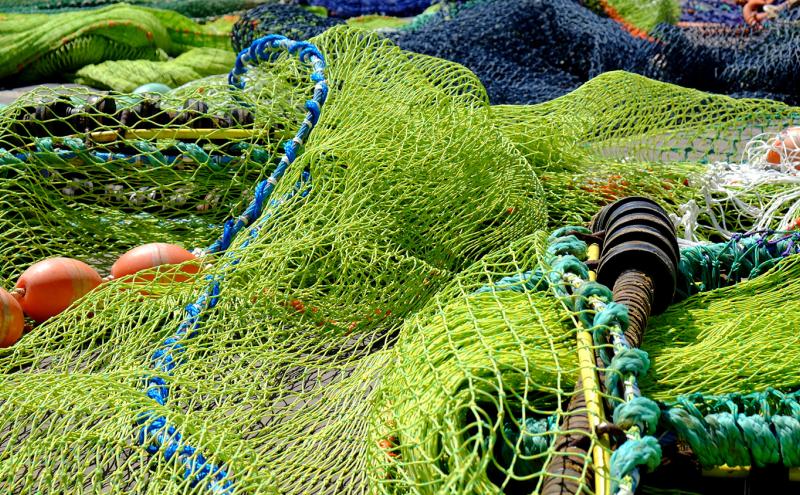
As a fisheries observer in Dutch Harbor, Kodiak, and Akutan, Alaska, Nicole Baker saw piles of fishing nets that were no longer usable everywhere. She knew there had to be a sustainable way to dispose of old fishing gear. After some research, she connected with a company that recycled maritime materials, and Net Your Problem was born. “The business was born basically just to connect those dots of taking material that I knew existed from my career as an observer and then sending it to a final disposal destination,” she said.
Today Net Your Problem provides fishers with a way to recycle old nets. The organization establishes programs to dispose of waste in remote fishing communities and currently operates in Alaska, Washington, Oregon, Maine, and Massachusetts. “If it's something that can be recycled, it should have another life. It shouldn't just have its life as a net and then never be useful again,” Baker said.
Since Baker launched the company in 2018, she has helped recycle over two million pounds of fishing gear plastics. Fishing gear gets recycled into recognizable products like phone cases, credit card readers, buckets, kayaks, and office furniture.
Net Your Problem spread its wings in Maritime Blue’s Maritime Accelerator inaugural cohort in 2020, designed to help maritime companies innovate and grow.
- Learn about Net Your Problem’s experience in the Maritime Accelerator program
Net Your Problem is a labor of love for Baker, combining her passions for protecting the environment and making authentic connections with the fishing community.
“I love hanging out with fishermen and communicating why they should care about recycling, and the cool stuff that can be made,” she said. “These are incredible interactions for me. No matter where I am I have the same feeling. I love having relationships with my customers and those who I hope will be my customers. I get to travel to all these cool places in Alaska where not a lot of people get to go and feel like I am truly making a difference.”
Many companies say they want to be sustainable but are very general about how they are going to do that, Baker said. Recycling is a tangible way that companies can be more sustainable. “We are part of the solution and doing very hard work to make that happen,” Baker said. “When containers get loaded up and shipped off, and we close the door, it feels great to know it’s not going to the landfill and going to be turned into something else.”
Green partnership
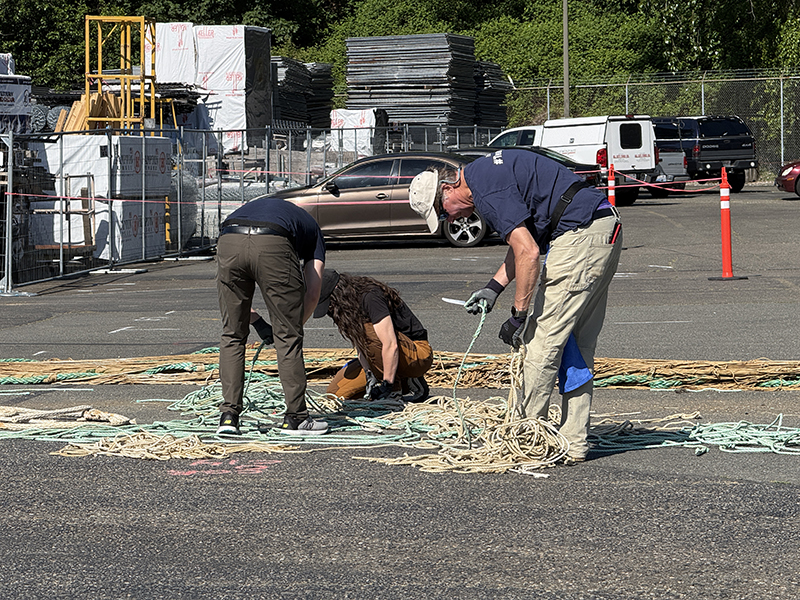
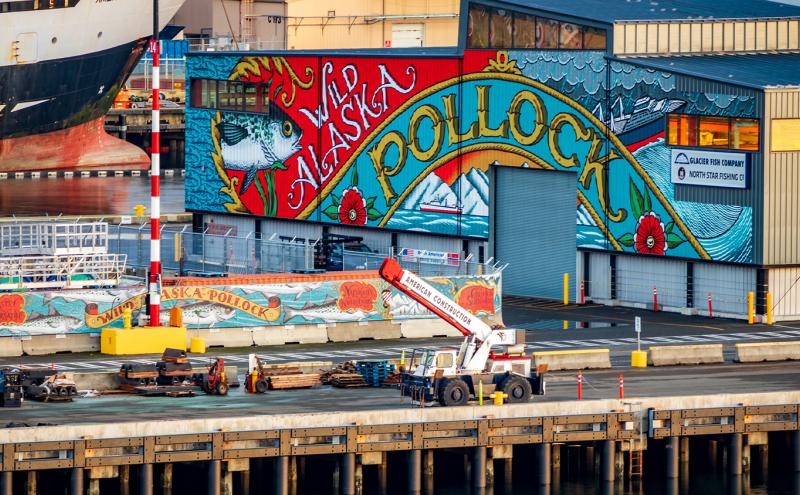
American Seafoods, the world’s largest at-sea processor of Wild Alaska Pollock with offices in Seattle, Dutch Harbor, Europe, and Asia, started working with Net Your Problem to recycle their retired nets in 2019. Recycling can be a concrete part of any business’s sustainability strategy, and American Seafoods is a great example of a company that is walking the talk and doing this, Baker said.
In the beginning, Baker helped American Seafoods load nets from Dutch Harbor on ships headed to Bulgaria, where they were taken apart before going to a recycling facility in Denmark. Since 2019, the plastic waste trade has evolved, causing Baker and businesses like American Seafoods to update their recycling processes.
Now, plastics must be sorted into homogenous loads before they are sent abroad to be recycled, which involves manually taking the nets apart prior to export.
Breaking it down
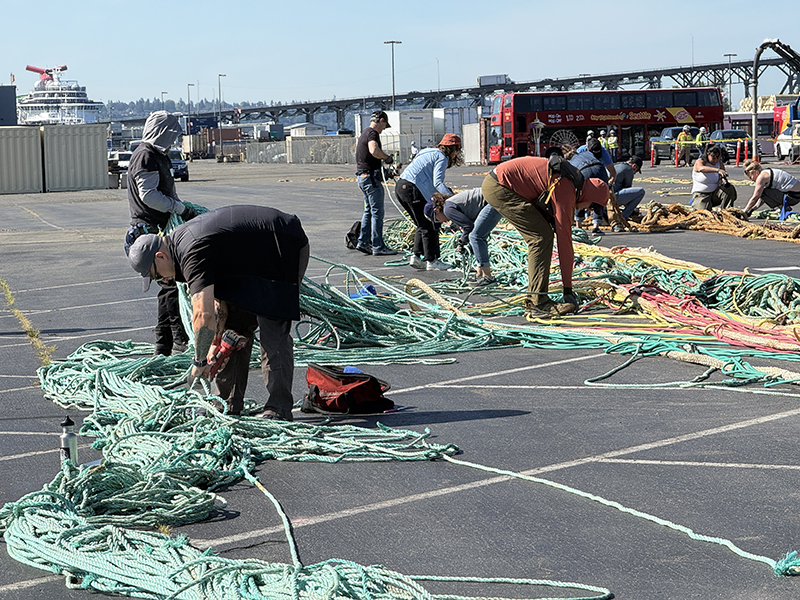
Before Baker can send the plastic off for recycling, the nets must first be dismantled by knives. “Nets are built by hand and taken apart by hand,” Baker said.
Recently, more than 165 volunteers gathered at Terminal 91 for the industry’s annual Net Recycling Day, transforming retired fishing nets into reusable materials through a collaborative, hands-on recycling effort.
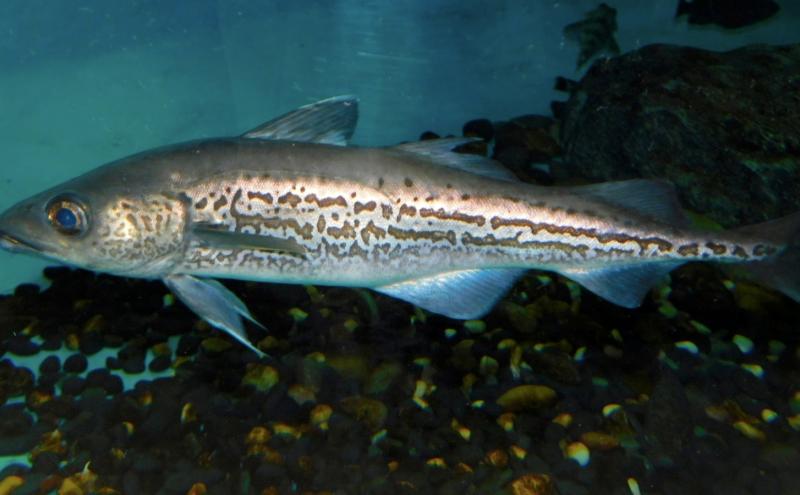
What started as a partnership between Net Your Problem and American Seafoods, is now in its second year as a fleet-wide initiative. The effort, co-organized by Net Your Problem, is part of a shared commitment to responsible stewardship across Seattle’s Wild Alaska Pollock catcher-processor fleet. The event brought together volunteers from five leading fishing companies — American Seafoods, Arctic Storm Management Group, Coastal Villages Region Fund, Glacier Fish Company and Trident Seafoods, alongside industry partners, working to dismantle and prepare end-of-life fishing nets previously used in the harvest of Wild Alaska Pollock, the world’s most sustainable whitefish. The process involves cutting, sorting, and processing retired nets for recycling.
Net Recycling Day builds on longstanding recycling efforts led individually by Wild Alaska Pollock companies and reflects the sector’s broader investment in circularity, innovation, and responsible resource management.
Volunteers processed 55,934 pounds of net (from Trident, Arctic Storm, and American Seafoods), with another 15,000 pounds of chain for recycling, keeping approximately 70,000 points of plastic and metal out of the landfill. Since the first Net Recycling Day in 2022, volunteers have helped recycle over 262,540 pounds of net.
The recovered net material will be sent to specialized recycling facilities, where it will be repurposed into durable consumer and industrial products such as composite decking, outdoor furniture, sports equipment, and other long-life materials — extending the value of gear that has already played a critical role at sea.
“Sustainability is built through continuous improvement,” said Matt Tinning, CEO of the At-sea Processors Association. “Events like this demonstrate that innovation in our industry extends well beyond the vessel deck — it includes how we rethink materials, reduce waste, and work collectively to strengthen the future of responsible fisheries.”
Reimagining sustainability
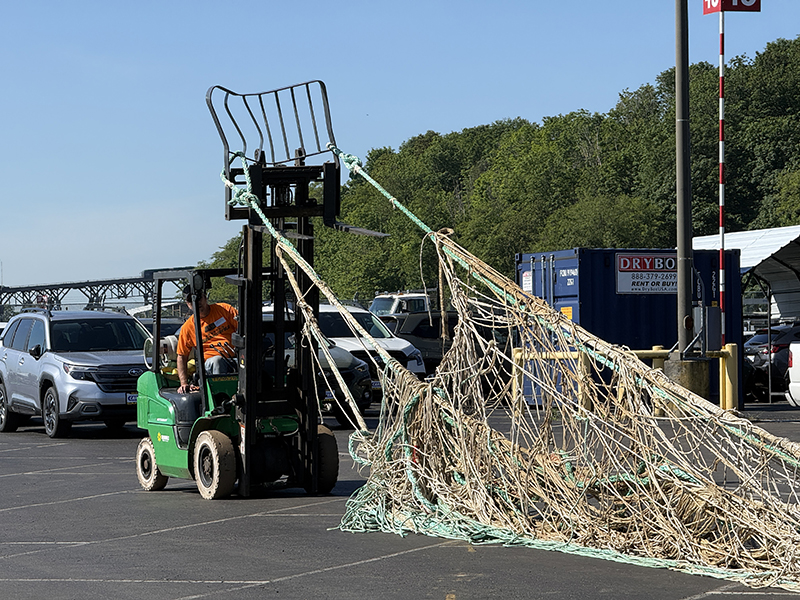
Partnerships with Net Your Problem has allowed companies like American Seafood to rethink other aspects of sustainability in their processes.
“With Nicole’s help we’ve been thinking about ways to keep recycling closer to home with less cost, more traceability, and more certainty about where materials end up,” said Tim Fitzgerald, Chief Sustainability Officer for American Seafoods.
Fitzgerald said he would also love to see American Seafoods using more products made from recycled materials.
“I want to get to the point where recycling and reuse is standard operating procedure. In an ideal world, I’d love to see our nets recycled into products we already use for our business — things like sorting baskets, plates, cups and trays for the galleys, and hard hats could all be made from our own recycled nets.”
The first shipment Baker processed for American Seafoods was 147,000 pounds, amounting to six to seven old nets (the same weight as an adult blue whale).
“Any fishing company could do this. Any seafood company can do this. We have a lot of nets and they generally fish for three or four years. And then when they're done, they just sit here in storage at the Port,” Fitzgerald said. “One of the great things about the net recycling program is that it's a good example of sustainability not needing to be high tech. These materials, once they're broken down and separated properly, are pretty easily recyclable.”
Fitzgerald said the recycling is just the beginning as American Seafoods continues its sustainability journey.
“Net recycling is just one part of the story. There are lots of other things our company uses where we want to adopt that same enthusiasm — everything from packaging to equipment. One of my goals for broader sustainability efforts at American Seafoods and the industry more broadly is to bring that mindset to everything we buy, and get a better grasp on what end of life looks like for more of these materials.”
Easy wins for sustainability are not as difficult as we think they might be, Fitzgerald said.
“Using less of something, switching to more responsible materials, buying things from local vendors. A lot of this actually looks like logistics, procurement, and operations — things we don’t often call sustainability.”
Fitzgerald said he is happy to see net recycling become more widespread across the fishing industry.
“If others in the industry want to come do it with us, we have a lot more power to wield as a group; we are all generally doing this for the same reason,” he said. “I’m happy to help any other fishing company with adapting this for their own operation.”