February 18, 2026
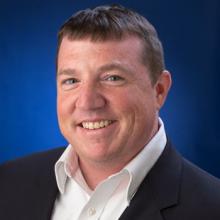
As a child, Ty Juvinel spent hours drawing and working with wood alongside his grandfather and uncle — experiences that planted the seeds for a career he never imagined was possible. Today, Juvinel, a Tulalip Tribes member, is a Coast Salish artist whose work can be found across the region, including a newly installed sculpture at the Port of Seattle’s Maritime Innovation Center (MInC) at Fishermen’s Terminal.
Juvinel’s journey to becoming a professional artist was nonlinear. He started out as an electrician at Valley Electric, a union job, following in the footsteps of his stepfather and father, who worked in construction. But he felt like something was missing.
“I knew I had to give being an artist a shot. I had to try or else I wouldn’t be able to live with myself,” he said. So he enrolled in the Art Institute of Seattle for audio production and live sound, and started working at nightclubs and live music venues. He enjoyed it for a while but soon got tired of the late hours and lack of connection. Juvinel later moved back to the Tulalip Reservation and began working in marketing and graphics for the Tulalip Tribes.
Finding a future in carving
When he discovered the Tulalip Tribes had its own carving department he was intrigued. “I didn’t realize that was something you could make a living at,” he said.
He jumped right in, earning a spot as an apprentice carver and absorbing as much knowledge from his mentors as possible. Juvinel found the work combined the artistry and hands-on construction he enjoyed, particularly working with wood.
Tribal carving projects vary depending on community needs, and include paddles, masks, house posts, and panels. Juvinel also does outreach with tribal schools and organizations to share information about carving careers.
“Right now I'm trying to get our youth more involved and introduce them to carving as a career because there aren’t a lot of carvers who are younger than me,” he said.
Art rooted in community
Under his company, Tribal Lines, Juvinel has created pieces using a variety of media for the Seattle Children's Museum, the Burke Museum of Natural History and Culture, Seattle Public Library, Hibulb Cultural Center, Edmonds Historical Museum, City of Edmonds, City of Olympia, Museum of History & Industry, and more.
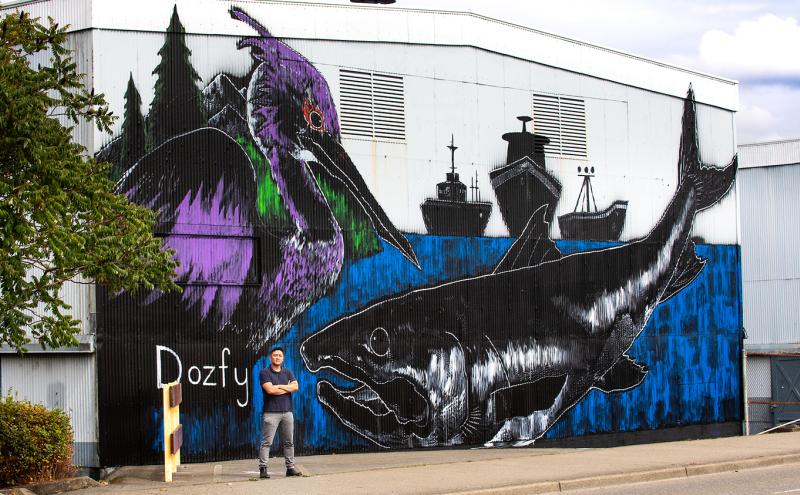
In addition to sculptures and carving, he creates graphics and murals and writes and illustrates children’s books. In his work, he is inspired by community stories and his cultural background as a Tulalip Tribes member, collaborating with clients to create pieces that reflect both their needs and his artistic vision.
From proposal to public art
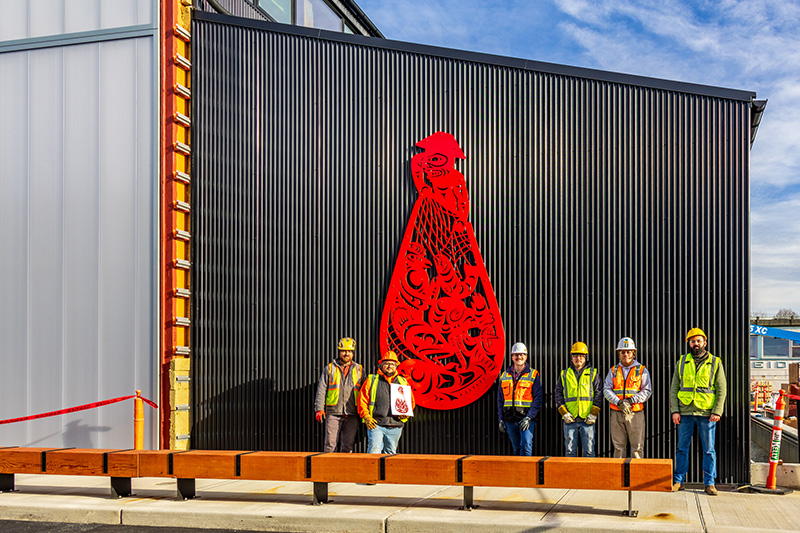
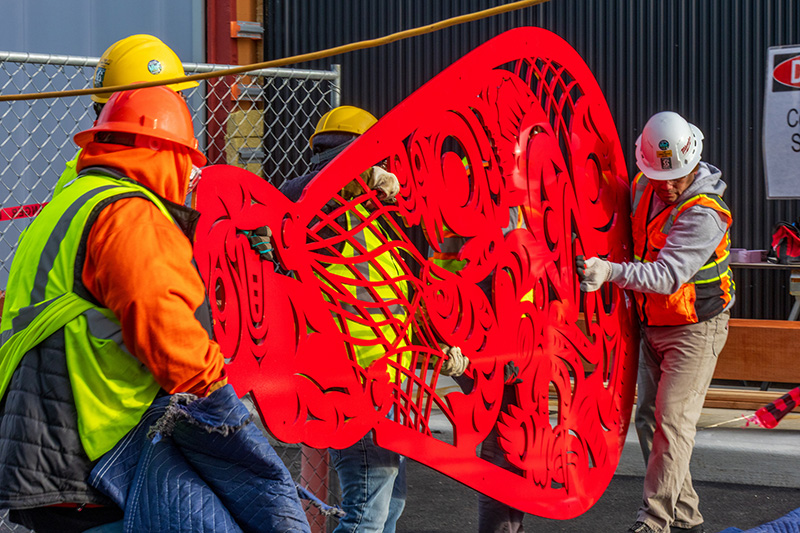
Juvinel initially applied for a Request for Proposals (RFP) to create a piece for Seattle-Tacoma International Airport (SEA), but when he wasn’t selected, he was encouraged to apply for an upcoming RFP for a piece at Fishermen’s Terminal’s Maritime Innovation Center (MInC). The piece needed to focus on fishing in the Pacific Northwest, weaving in elements of history, culture, and the heritage of fishing in our region. Juvinel was selected for the job and finished installing the piece in December 2025.
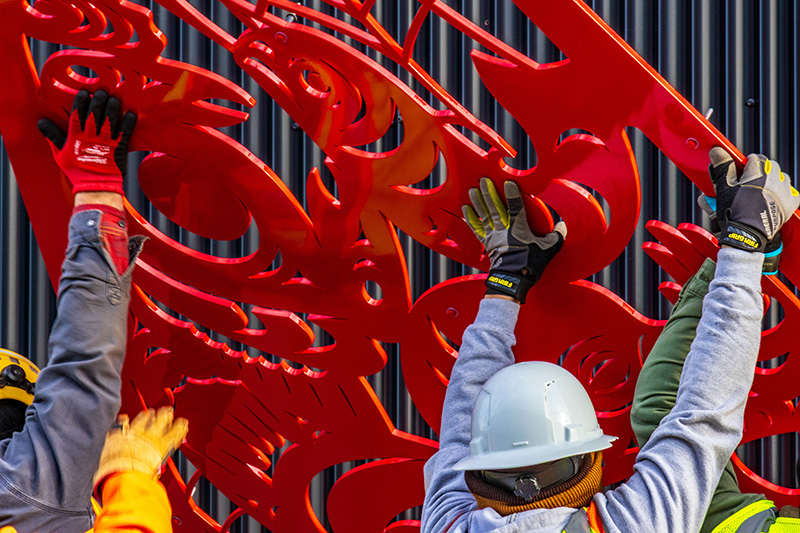
The sculpture, titled “Beach Seining,” is a 12-foot aluminum piece inspired by a traditional community fishing practice rooted in collaboration. In beach seining, members of a community work together to stretch a net from shore to shore, forming a wide U-shape that is then drawn in to gather what the water provides.
The piece features sockeye salmon, Dungeness crab, oysters, octopus, and geoduck captured in the net — a reflection of the diverse seafood that passes through Fishermen’s Terminal and a nod to Tribal fishing traditions and divers who have sustained these practices for generations.
“I hope that when people see the sculpture, they start to look at tribal art as valuable as other artwork, because it isn’t always taken as seriously,” Juvinel said. “We have a story we're trying to tell and a message we’re trying to convey.”
Juvinel said it is critical that artists have the freedom to tell authentic stories about their experience. He emphasized that Indigenous art in public spaces like Fishermen’s Terminal provides visibility, challenges outdated perceptions, and creates opportunities for learning. “It’s important just to be represented and be out there so people can learn,” he said.
Encouraging the next generation
As he works with tribal youth, Juvinel encourages them to start following their dreams now, reminding them that progress takes time.
“Don’t wait because if you wait five years you could already be five years better,” he said. “That’s the one big thing I try to preach to kids when I work with them.”
Juvinel also reminds students not to get hung up comparing themselves to others. “A lot of our thoughts are negative, and it's easy to get caught up and stop yourself from achieving what you want,” he said.
Up next, Juvinel is working on murals at 4th and Yesler streets and for Raven Village in Ballard — continuing to bring Coast Salish stories, culture, and community into public spaces across the region.
Subscribe to Pier to Pier for adventures on the working waterfront