
Serve with Purpose. Train with Excellence. Protect a World Gateway.
The Port of Seattle Fire Department (POSFD) protects one of the nation’s busiest airports Seattle Tacoma I international Airport (SEA). Our firefighters provide Aircraft Rescue Fire Fighting (ARFF), structural fire response, advanced EMS, hazardous materials mitigation, and technical rescue for millions of travelers, employees, and community members every year.
We are a department built on teamwork, professionalism, and continuous growth. If you’re looking for a career where your work matters and your team feels like family, you’re in the right place.
Who We Are
Since 1955, POSFD has grown from a small airfield fire crew into a modern, multi discipline department with more than 90 firefighters, officers, inspectors, and training staff. As SEA continues to expand, so does our mission and our team.'
We are known for:
- High skill ARFF operations
- Strong EMS response
- A culture of mentorship and camaraderie
- Opportunities to specialize and lead
- A commitment to Save. Protect. Serve
Our firefighters rotate through all apparatus and assignments, gaining deep experience across the department. Many pursue advanced roles in:
- Technical Rescue
- Hazardous Materials
- Fire Prevention
- Training & Instruction
- Special Projects and SME roles
Why Airport Firefighting?
Working at an international airport means:
- Fast-paced, high impact response
- A unique blend of aviation, medical, and structural firefighting
- Close knit teamwork due to our compact response area
- Daily opportunities to train, learn, and grow
If you want a career that challenges you and a team that supports you, airport fire service offers both.
How to Become a Port of Seattle Firefighter
We hire entry-level firefighters through a structured, transparent process designed to identify candidates who are ready to learn, serve, and grow.
- Written & Physical Testing
The Port partners with Public Safety Testing (PST).
Candidates select their test date and location through PST, and scores are automatically sent to the Port.
Learn more at Public Safety Testing: https://www.publicsafetytesting.com/ - Oral Board Interview
Qualified applicants are invited to participate in a panel interview with members of the department. - Background & Screening
Finalists complete:- FBI criminal history check
- TSA background check
- Pre-employment drug screening (with possible random testing during probation)
- Conditional Offer & Academy
Successful candidates receive a conditional offer and begin their training journey with POSFD.
Minimum Requirements
Applicants must:
- Be 18 years of age or older
- Be a U.S. citizen
- Hold a high school diploma or equivalent
- Possess or obtain a Washington State driver’s license
- Obtain EMT certification within one year of hire
How to Be Physically Ready for the Fire Academy
Fire academy is physically, mentally, and emotionally demanding. Passing the Candidate Physical Ability Test (CPAT) is only the beginning. The South King County Fire Training Consortium outlines clear fitness standards that help predict success in the academy.
Learn more about the Academy Physical Fitness Standards (PDF) https://pugetsoundfire.org/wp-content/uploads/2022/02/Recruit-Academy-Physical-Fitness-Standards.pdf
Minimum Physical Fitness Standards
- Recruits should arrive able to complete:
- Two mile run: 18 minutes or faster
- Push ups: 25 repetitions in 2 minutes (80 bpm cadence)
- Plank: 2 minutes
- Chin ups: 1 repetition (underhand grip)
These are minimum expectations
Top Scoring Performance Benchmarks
For recruits aiming to be highly competitive and physically confident, the following represent a perfect score on academy fitness evaluations:
- Two mile run: 12:00 minutes or faster
- Push ups: 50 reps in 2 minutes
- Plank: 4–6 minutes (6 minutes = top score)
- Chin ups: 20 reps
These benchmarks reflect the strength and stamina needed to thrive in daily academy PT.
What Physical Training Looks Like in the Academy
Recruits can expect:
- Daily instructor led PT
- Running (varied distances and intensities)
- Strength circuits
- Core endurance work
- Work capacity drills
- Evaluated fitness tests throughout the academy
A supportive pair of running shoes is strongly recommended.
How to Start Preparing Now
- Running: Build up to 2–3 miles, 3–4 times per week
- Strength: Push ups, pull ups, planks, squats, lunges
- Work capacity: Intervals, stair climbs, sled drags, weighted carries
- Consistency: Slow, steady progress beats sporadic hard workouts
CPAT is the minimum. Academy fitness is significantly more demanding.
What It’s Like to Work Here
POSFD is known for its supportive, team oriented culture. Firefighters train together, learn together, and build long careers together. Members choose stay for decades because they value:
- Strong leadership
- A sense of purpose
- Opportunities to advance
- A department that invests in its people
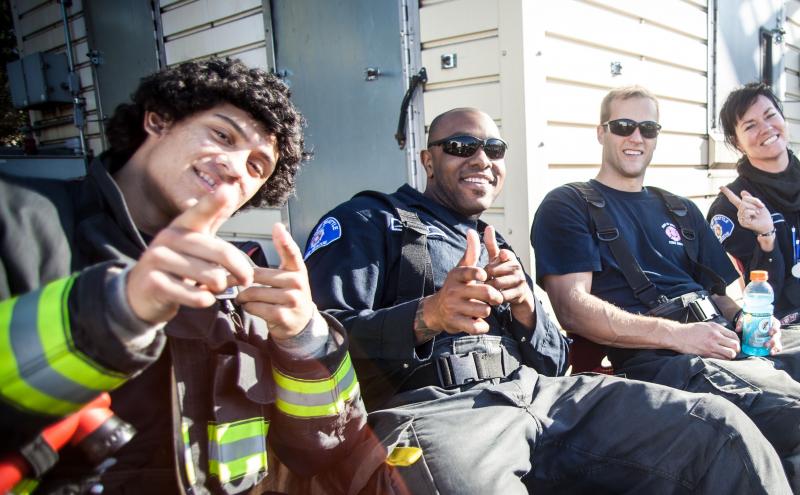
We take pride in our work, and we have fun doing it.
Ready to Start Your Journey?
Explore testing opportunities, learn more about our department, or connect with our team.
- Learn more about Public Safety Testing (PST): https://www.publicsafetytesting.com/
- Learn more about the Academy Physical Fitness Standards (PDF): https://pugetsoundfire.org/wp-content/uploads/2022/02/Recruit-Academy-Physical-Fitness-Standards.pdf
- Visit the Port of Seattle Fire Department: https://www.portseattle.org/
- Contact Port of Seattle Human Resources
Attn: Cathy Cameron — 206 787 7727